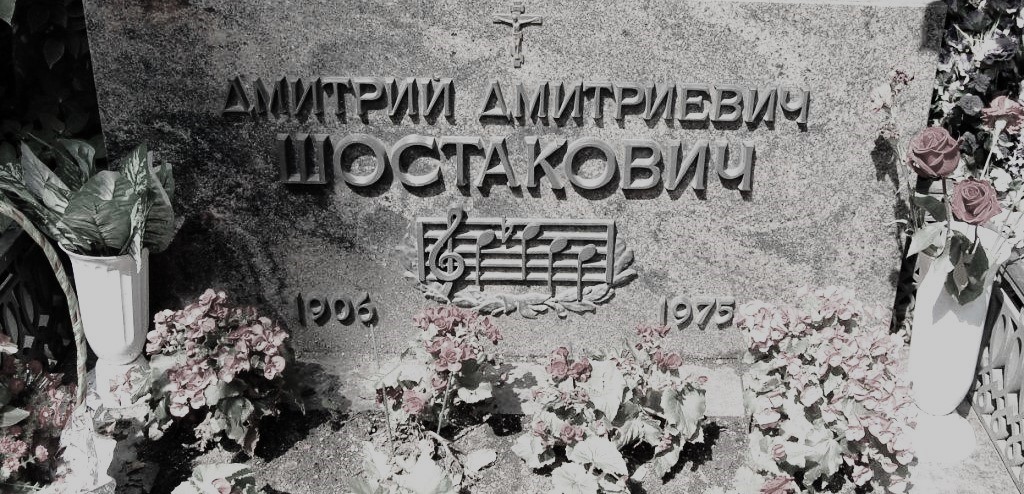
2025 marks 50 years of human existence since Dmitri Shostakovich died in 1975. It is nothing to celebrate – the anniversary of a great artist’s death – but 50 is a significant number – the Romans gave it its own letter – and so it provides a good excuse, if one was needed, to appreciate and acknowledge Shostakovich’s enduring genius as this planet sputters wretchedly on in its dead-end course.
Speaking of space, Dmitri Shostakovich is the sun about which my listener-free radio show and I (crumpled sheets of space junk, relatively speaking) orbit. His music says more to me about the world and all its complexities, beauty and horrors than any musician’s I know. He wrote a ton of music I have no need to hear again, but another ton that I can’t live without. I have chosen 120 minutes-worth of favorite moments from my favorite performances of my favorite Shostakovich works for this mixtape.
I called this mix “Gravest Hits” – as opposed to “Greatest Hits” – for a few reasons. For one thing, most – but not all – of the tracks are on the haunting/melancholic side. In fact, several of the sung songs are straight up about death. While many Shostakovich fans are drawn to his exuberant youth in the optimistic, pre-Stalinist Soviet Union, with the exception of the mournful adagio of 1931 (which turned up in Katerina’s Aria in Act 1, Scene 3 of Lady Macbeth) there is none of the callow precocious Shostakovich in this mix. By the time the next chronological selection on this mixtape appeared (the piano quintet of 1940), Shostakovich had been harshly censured by the Soviet art thugs (for Lady Macbeth) and Stalin’s Great Terror had murdered hundreds of thousands of his countrymen, including many of his friends. Everything else postdates the death of his closest friend and mentor, Ivan Sollertinsky, not to mention the Nazis’ genocidal incursion that starved or froze to death some 1.5 million in Shostakovich’s hometown of Leningrad.
For another thing, calling this a “greatest hits” selection would simply be confusing. Aside from the piano prelude and the second piano trio (three of whose five movements appear here), I doubt many of my other selections would appear on any Shostakovich scholar’s hypothetical 2-CD Best of.
And finally, I called it Gravest Hits because I was and to an extent remain a huge Cramps fan and they called a compilation of their early 45s on 12” “Gravest Hits.” Which I only mention in case anyone noticed… (Yes, it is possible to love the Cramps and Shostakovich and many other things, too.)
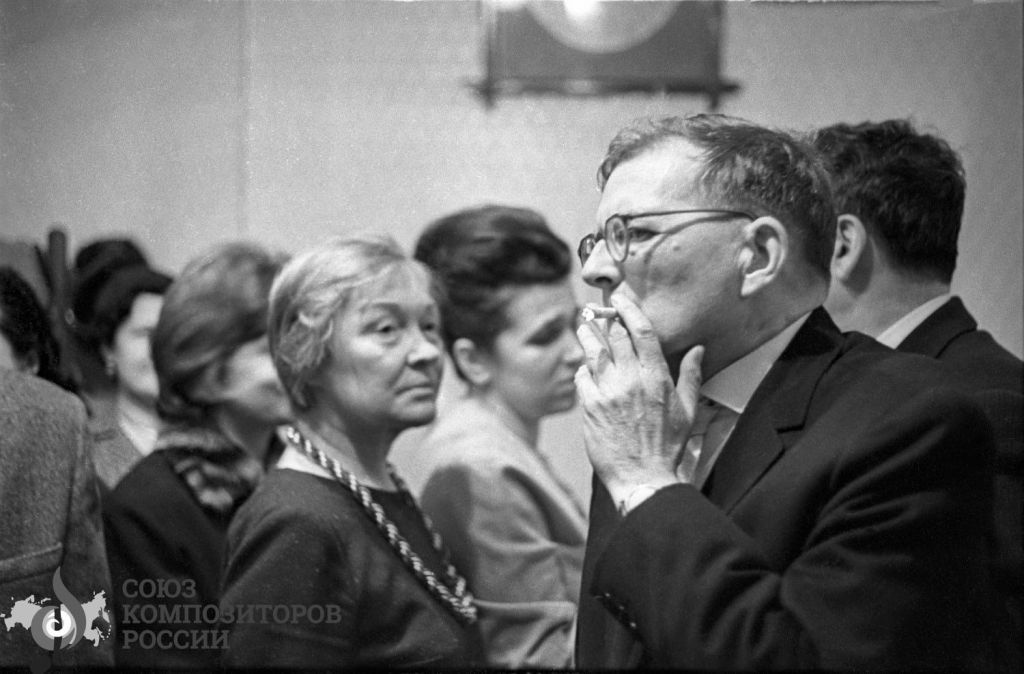
I made this mixtape in part to promote Shostakovich to listeners who may not have heard his best work, and I tried for a nice flow. With one exception (the short String Quartet No. 7), all of the tracks are movements or excerpts from longer works, with the idea of keeping things moving along for those of us with battered attention spans.
I want to emphasize that I’ve listened to multiple recordings of all of these pieces and selected my favorites. There are many excellent recordings of amazing performances of most of these works, and I certainly have not heard them all, but these are the ones I happen to love the most. I stress this because there are a few outliers on here, most notably the movement from the first violin concerto performed by a young Japanese woman who only ever made one other record that I can find online before she vanished, at least from internet search results. But her version was a revelation to me.
Along those lines, another quick observation regarding the selections: I used to stick entirely to Soviet/Russian performers when it came to Shostakovich, which is a sound-enough strategy in that the works were all written for, premiered by and championed by great Soviet artists and orchestras. However, as years have gone by I’ve come to realize that strategy is stupid. Transcendent artists create for the whole world, and Shostakovich, who worshiped Mahler and Beethoven, was not trying to write exclusively Russian music.
0:00:00
Two Pieces for String Quartet, Op. 29 (1931)
Emerson Quartet
Deutsche Grammophon (2000/2023)
0:04:28
Symphony No. 14, Op. 135 (1969); II. “Malagueña”
Julia Varády w/ Bernard Haitink: Royal Concertgebouw
Decca (1981)
0:07:02
24 Preludes and Fugues, Op. 87 (1950-1); Prelude No 4 In E Minor. Andante
Alexander Melnikov
Harmonia Mundi (2010)
0:09:50
Katerina Ismailova Suite ; Intro
Michail Jurowski: Berlin Radio SO
Capriccio (1999)
0:12:20
Piano Quintet in G-minor, Op. 57 (1940): I. Prelude
Vladimir Ashkenazy & the Fitzwilliam Quartet
London (1986)
0:16:59
Satire, five songs to the words of Sasha Cherny, op.109 (1960)
Magdalena Kozena (mezzo) w/ Malcolm Martineau
Deutsche Grammophon (2004)
0:17:59
King Lear, op.137 (1970); Signal No. 1
Leonid Grin: Berlin Radio SO
Capriccio (1988)
0:18:57
Symphony No 11 in G minor, Op. 103 (1957); I. “The Palace Square”
Bernard Haitink: Royal Concertgebouw
Decca (1993)
0:34:48
The Gadfly Suite, Op. 97A (1955, arranged by Levon Atovmyan); Nocturne
Leonid Grin: Berlin Radio Symphony
Capriccio (1989)
0:38:53
From Jewish Folk Poetry, Op. 79A; 1. “Lament for a dead baby”
Marina Zhukova or Elena Svechnikova w/ Vladimir Spivakov: Moscow Virtuosi
MusicMasters (1997)
0:41:36
Violin Concerto No. in A minor, Op. 77; III. Passacaglia; Andante
Mayuko Katsumura w/ Enrico Marconi: London Symphony Orchestra
Green Room (2016)
0:55:11|
Piano Trio No. 2 in E minor, Op. 67 (1944); III. Largo
Martha Argerich, Maxim Vengerov & Gautier Capuçon
EMI (2011)
1:01:07
Hamlet Suite, Op. 116A (1964); “The Ghost”
Leonid Grin: Berlin Radio Symphony
Capriccio (1989)
1:06:33
7 Romances on Poems by Alexander Blok, Op. 127; No. 7. Music
Elisabeth Söderström w/ Vladimir Ashkenazy, etc.
London (1986)
1:11:12
String Quartet No. 7 in F# minor, Op. 108 (1960)
St. Petersburg Quartet
Hyperion (2001)
1:24:33
From Jewish Folk Poetry, Op. 79A (1948); No. 2 “Solicitous Mother”
Marina Zhukova & Elena Svechnikova w/ Vladimir Spivakov: Moscow Virtuosi
MusicMasters (1997)
1:26:41
Piano Trio No. 2, Op. 67; IV. Allegretto
Martha Argerich, Maxim Vengerov & Gautier Capuçon
EMI (2011)
1:37:49
6 poems of Marina Tsvetaeva, op.143; No. 4, “The Poet and the Czar”
Elena Zaremba w/ Neeme Järvi: Gothenburg Symphony Orchestra
Decca (1995)
1:39:20
Violin Concerto No. 2 in C-Sharp Minor, Op. 129 (1967); I. Moderato
Christian Tetzlaff w/ John Storgards: Helsinki PO
Ondine (2014)
1:53:10
Suite on Verses of Michelangelo Buonarroti for bass and piano (1974) ; X. Death
Matthias Goerne (bass) w/ Daniil Trifnov
Deutsche Grammophon (2022)
 Concentration Camp