Concentration Camp Bookshelf, or How to Learn a Lot About Classical Music FAST

dscf5237a

The purpose of this blog is to – hopefully – serve as an introduction to a vast realm of incredible music, much in the way an all-night radio station in Chicago did for me years (and years and years) ago. I understand and am comfortable with the fact that no one reads this blog, but at least it’s out there and maybe a few people somewhere (and with the internet, “somewhere” is anywhere) at some point will find it.

That right there is the mission statement for the blog.

The music to which I refer is of course that of “classical” composers in Europe and the Americas since, roughly, 1900. I have not gone further back than Dvorak, Sibelius, Mahler and Brahms, mainly because the 20th and 21st century stuff resonates with me in ways Mozart or Haydn, say, never did. It’s sacrilege, I know, but there’s also the fact that I don’t have enough time left (I’m 58) to even think about Beethoven. Even if I live to my projected lifespan, I doubt I’ll die with a solid grasp of Shostakovich or Schnittke or Bartok (composers I listen to all the time), let alone Britten, Stravinsky, et al. Time waits for no one, and it won’t wait for me.

So “narrowing” the scope to the last 1.2 centuries still leaves an imponderable expanse. Many of the great composers of this period had interesting and creative careers that spanned forty or fifty years, well into advanced old age (which, as one on the cusp of his senior years, draws me to it all the more.) There are thousands of works and multiple performances of many, and much of it, frankly, is not all that interesting. Plunging in is great, but having some guidance is essential or you’ll get bored fast. One excellent way to learn about something, I feel it necessary to say, is reading, and I offer this blogpost as a reading list you might consider if you want to understand the music better. Because – and this is another reason the music resonates with me – this modern classical, as much as any art form of its era including film – reflects the immediate circumstances in which it was written, and an understanding of the social and personal context lends the music a vitality and purpose you would lose without such knowledge. Often, the context was harrowing. Take Shostakovich, for example, perhaps the greatest white musical genius of the 20th C. His biography makes his life’s work – including the dull, lesser stuff, which he wrote to appease the Man of Steel so THAT HE WOULD NOT BE MURDERED BY THE SECRET POLICE – understandable and approachable. Shostakovich created great art in a nightmare world, a world that passed from Lenin to Stalin to Khruschev and ultimately – sadly – into Breshnev (Shostakovich died in ’76). His achievements – already monumental – take on an otherworldly aura in light of that. (And I highly recommend the biography pictured with surveys on the shelf above, by a psychologist (fittingly) named Stephen Jackson from; it is another book I would consider among the best I’ve ever read on music.) Just as Samuel Barber’s and Benjamin Britten’s lives as gay men in an inhospitable, homo-sterilizing era lends a deep and varnished sadness to their music, and just as Karlheinz Stockhausen’s adolescence in Nazi Germany at the height of the war had to have influenced everything he ever did… I can not emphasize this enough: the music gains immensely from context.

So, these are the books I’ve learned a lot from over the past couple years. There are other titles out there, I know, that I might learn a lot from but that have not crossed my path, or at least not in an affordable manner. And I’m hardly done reading these. I refer to these books constantly while putting together my radio show on WSFM (ashevillefm.org).

I will the begin with the book I learned the most from, and work so on down the line. I am rating the books in terms of $ because this is America and that’s what we understand. But it’s a good measure: I have to buy this stuff, after all. The prices after the synopses, then, are, first, what I’d pay to replace the book if I had to; the second price is what a “Very Good” or better copy costs on Amazon (as of this moment, anyway…) You should keep in mind that I’m poor, living below the poverty line (and totally fine with that, thanks), so $25 is a SHITLOAD of money to for me spend on a book. And I hate to endorse Amazon, but at this point it’s sort of like buying gasoline for your car – a necessary evil.

41bvxdu-zhl

Alex Ross: The Rest Is Noise
(Penguin, 2007)

The Rest Is Noise is one of the really good books I’ve read on any kind of music*, and is at this point – with its bestseller status along with the author’s podcast and an annual NYC festival of the same name – as close to iconic as a book about classical music in the age of AI and cyber warfare could be. The subject matter here dovetails exactly with the music considered in Concentration Camp (late 19th century to the present) and, along with Dan Carlin’s hardcore history, is the main non-musical inspiration for this largely pointless endeavor. But the Rest Is Noise is most valuable precisely because its purpose is to put the music in a linear, historical context. One reviewer on Amazon gave it two stars, I think, complaining that there was “too much history.” That reviewer, I immediately thought, had to be an American, because in America history is just a tedious high school subject and one that, like other print-centered media, is getting dumber all the time.

Twentieth century history to most Americans is how “we” won the two World Wars, Rosa Parks and the Martin Luther King “I Have a Dream Speech,” and Ronald Reagan. Well, it seems we’re making some history now, so trying to understand what Europe experienced in terms of… oh I dunno, fascism and racism and genocide might help in understanding the world we now find ourselves in, where a sort of Capitalist totalitarianism looms inescapably on the horizon. (By capital C Capitalist, I mean a completely rigged system based on weightless abstractions of the financial realm and beholden to a single motive: profit.) The rise of aggressive nationalism that birthed the first world war, the contempt for capitalism that prompted multiple revolutions (ending, for the most part, disastrously), the psychotic racial hatred and the wrenching paranoia that led to World War II and the Holocaust ARE all worth considering and understanding. History does repeat itself because there are, ultimately, a finite number of plotlines (which is why studying classic lit is, for good readers at least, important in high school), though certainly new elements and new sorts of tyrants – like Trump, a brand name sticker on a suicidal 4-year money grab – arise as evil evolves alongside technology and its increasingly frantic pace.

In The Rest Is Noise, Alex Ross effectively discusses the poisonous tides that swept across Europe in his discussions of Eastern European and Russian composers like Bartok and Kodaly and Shostakovich – but he gives significant space to other storylines, interesting ones, like the importance of homosexuals in classical music (notably Britten and virtually every important American composer other than Ives), or the CIA-sponsorship of ultra-abstract music like Stockhausen’s in Germany after the war (so as not to awake another Hitler with exhilarating Romanticism like Wagner or Richard Strauss).

Of course, the subject matter – the 20th century – is still so vast that the book is necessarily an overview much of the time and some of my favorite composers are barely mentioned or not mentioned at all. It would be nice to see Ross write a longer book from any of a half dozen chapters in The Rest Is Noise. But this is an important book, one that would need to be written – or understood – before appreciating or expanding upon any of his chapter topics.

It must sometimes seem a burden for Ross, seeing as he’s the only classical music critic well-known to the point he’s read by laymen. Ross knows the technicalities and is sometimes compelled to break stuff down, but because he is such an efficient writer that is only mildly tedious to someone like me, who only wants to hear the stories and understands little-to-nothing about the technicalities.
     WORTH: $75; USED VG $4.15

51cf1wwaxpl

Alexander J. Morin (editor) The Third Ear Essential Listening Companion to Classical Music.
(Backbeat Books, 2002)

This is to me by far the best of the telephone directory-sized overviews of all of classical music. It’s got the 11,000 pages and 3-pt. font of a big city phonebook, and espite untold scores of pages on Haydn and Mozart and Beethoven and Mahler’s symphonies, the modern stuff is not given short shrift within such a context. There are also scores – scores – of contributors, so almost every composer in the alphabetical listings is considered by a sympathetic writer, if not an outright fan. This is more of a help than a hindrance: if you like a composer, you want to hear other things you like by her or him. This book is like The Bill James Baseball Abstract or H.G. Wells’ Outline of History to me at this point. If I could only grab one book on the way out of my burning house, this would probably be it. (That or my autographed copy of The Tall Woman by Wilma Dykeman…) Because it is 14 years old – last time I checked mine is the most recent printing – it does not include discs released since (obviously) and is frustratingly briefer on composers – like the Scandinavians Norgard, Saariaho and Rautavaara – who have been effectively canonized more recently. (Real quick, if I was asked to provide a shortlist of late 20th C. composers whose music is almost constantly entertaining and markedly genius at the same time, that would be it. Well, and Schnittke.) But works and various interpretations of them by different performers (most of which are still in print or available through Amazon) are insightfully discussed at length by people who really, really know whereof they speak.
WORTH: $40; USED VG: $15.50

41wbo9fqzfl-_sx331_bo1204203200_

Norman Lebrecht: The Companion to 20th Century Music
(Simon and Schuster, 1992)

The only famous person I’ve interviewed to date suggests Lebrecht, still going, well-past the ’92 publishing date, is regarded as a prick or asshole by some musicians and composers. He’s an Englishman, and affects a prim and somewhat creepy aura in his jacket photo, looking like a big-haired intellectual from a ’70s Playboy despite the Clinton-era first edition. His writing follows suit. The famous person says that Lebrecht focuses on dirt and scandal or disgrace and leaves important things out of his brief entries in this book as well as his terse writing on his website that amount to mistruth. I suspect that’s exactly right based on an example or two I know more about than Lebrecht writes, but the book is an invaluable reference because of the people he writes about, who are otherwise barely- or unknown to laypeople. (I’m just going to go with the “lay” concept for now). I think there’s upwards of twenty composers whose work I nowadays devour that I’d never heard of until Lebrecht’s book crossed my path at a used book store. He writes longer essays about major composers, and his pages on Bartok, Ives, Ralph Vaughan Williams and Benjamin Britten, in particular, are forceful arguments for the greatness of each. He is an excellent writer in terms of saying a lot with a few words and he is pugnacious (“flippant” is how someone panned him in an Amazon pan), which is refreshing, to me. He’s sort of like a boxing reporter writing about the fringes of clasical music. Stuff he doesn’t particularly like – Philip Glass, e.g. – he disembowels with a swipe or two. (He has better regards for Steve Reich, which may give you an idea of Lebrecht’s vibe.) There must be several thousand entries, and I have discovered insane amounts of cool music by checking out Youtube while reading his dry and/or caustic blurb-bombs. A useful barometer: 140 words on Galina Ustvolskaya. In all the other books on the shelf, she is mentioned only once, and there in a series, with commas on either side of her.  [I have ordered a book Lebrecht published in ’97 called Who Killed Classical Music?: Maestros, Managers, and Corporate Politics but (obviously) can’t comment on it yet…]


     WORTH: $25; USED LN $.01

51zwsp-hbrl

Jan Swafford: The Vantage Guide to Classical Music
     (Vantage, 1992)

This one devotes 170 of its 520 pages to the 20th Century and is probably the most engaging-to-the- layman book on the list. Swafford, a composer himself, is able to write enthusiastically and amiably about music from all seven centuries covered in his overview. (I’m guessing, because I never read about anything from the time before Dvorak, Mahler, and Sibelius, and Satie and maybe Brahms. I don’t know why, but music from before that – even Mozart, Haydn, does nothing for me. Nothing – I turn it off immediately when I hear it on the radio. I guess you should bear that in mind. He has, in many of his four or five paragraph considerations of major modern composers, a lot of biographical material I’ve not encountered elsewhere, so it’s short but engaging.
     WORTH: $4; USED VG $3.76

51xp8knyqql

Harold C. Schonberg: Lives of the Great Composers
(Norton: 1997 (3rd Edition))
     [Note: NOT to be confused w/ Lives and Times of the Great Composers or Love Lives of the Great Composers         or (ewww) Sex Lives of the Great Composers…]

This was written by the longtime senior music critic for The New York Times, back in the Vincent Canby-era (1960s and ’70s), and Schonberg’s is sort of like Vincent Canby’s writing on films: intelligent but not to the point of intellectual, insightful, informative. Twentieth Century-wise, it has excellent chapters on Debussy, Ravel, Stravinsky, Prokofiev and Shostakovich, and Bartok (in that sequence), but I think I like Schonberg’s writing about the table-setters for modernism – Dvorak, Bruckner, Mahler and Scriabin among them – most in this book. No mention of Gloria Coates…
     WORTH $5; USED VG $4.76

511waray6ll

Paul Griffiths: A Concise History of Avant-Garde Music; From Debussy to Boulez
(Oxford University Press, 1978)

Griffiths has a more recent book, also from Oxford University Press, with a 3rd edition published in 2011, but A) from reviews, it seems as though the focus is on the more abstract composers and experimental composers who trace their lineage from Schoenberg (whose 12-tone works do not engage me AT ALL at this point) through the Darmstadt School and Cage to Luigi Nono and Berio and their ilk (much of whose work I do like, but not THAT much…), and B) it is not available at a price I can afford right now. I got a used library copy of A Concise History for a couple bucks… As the title suggests, this is a short book that covers the period I outlined above up to 1978, and it is about as long in sections on Boulez and Darmstadt as I care to read.

1978 is an unfortunate end date for a consideration of the avant-garde. The late ’70s and early ’80s marked a turning point in classical music, away from abstraction (or unlistenability) for its own sake and towards – or back to – tonality. The composers responsible – like Part, Gorecki and Rautavaara – are not discussed in this book. Which is not to say there wasn’t a lot of great music written by people – like Henry Cowell, Morton Feldman (NOT to be confused with Milton Babbit, the one famous for the famously smug and condescending “I don’t care if the public likes it” line), Ligeti and Messiaen – who were considered irrevocably avant-garde in their times. Unfortunately, only Messiaen is explored at any length in this book, and ALFRED SCHNITTKE IS NOT EVEN MENTIONED. Most interesting to me (if not exactly valuable, per se) are the passages that consider Bela Bartok’s role in the move towards the exceedingly challenging music with which Griffiths is obsessed, and the many photos and illustrations (some of the scores of composers like Ligeti, Messiaen, Berio and Stockhausen are visual masterpieces in their own rights…) laced throughout.

[P.S. I’m not crazy about the Darmstadt-related stuff, particularly Boulez, but I am open-minded. If anyone would care to recommend a Boulez piece that wouldn’t bore me shitless, you are welcome to comment on this blog post. As for Stockhausen, well, I may work my way backwards from his Licht operas of relatively recent times, which, I was happy to learn after begrudgingly clicking on a Youtube link (“I might as well at least check it out before I pan it…”), are beautiful and seem to be a perfect soundtrack for the new world order.]
     WORTH: $6; USED VG $.01

Robert Layton (ed.) The 2009 Penguin Guide to Recorded Classical Music
(Penguin, 2009 duh)

Vastly inferior in scope to the Third Ear Guide listed up top, it is a little newer and does include recordings not listed in the older tome. The writing is good and from authors well-versed in their subjects. The advice I’ve taken from it has been good. I got mine for free, so…
     WORTH: $2.50; USED VG: $24.47 (in other words, pass…)


Ted Libbey: The NPR Listener’s Encyclopedia of Classical Music
Workman, 2006)

As you might imagine from the cover and the NPR affiliation, this one is big font and packs the bite of a toilettop urn full of potpourri… It is worthwhile for me nevertheless, because it has entries for musical terminology that I don’t know and can often not pronounce, on the history of various instruments and forms, and it many, many entries for performers and conductors, as opposed to just composers. It skims the 20th Century but it alights on several people I didn’t know much about…
     WORTH: $2.50; USED VG: $.15 (G is $.01)

****************************

So, that’s my beginner’s library. These books will help you better understand the music that is played on Concentration Camp, which is essentially the funeral music for the end of Western Civilization. Because it did end there – Western Civilization, I mean – between the World Wars and the rise of hyper-capitalism and genocidal communism, right there on the continent (Europe) that begat it. A future post will look at some websites (besides Wikipedia, which is of course UTTERLY INVALUABLE and to which I donate annually) that have been very helpful.

____________________________________

*The best music books I’ve ever read without regard to genres would include Robert Palmer’s Deep Blues; Etta James’ autobiography Rage to Survive; Blues and the Poetic Spirit by Paul Garon, Stephen Calt’s Skip James biography I’d Rather Be the Devil; Leroi Jones’ Black Music (about the early ’60s free and post-bebop jazz scenes), and Simon Reynolds’ Rip It Up and Start Over Again about postpunk.

Concentration Camp Mixtape #3: Julius Eastman in trumpland.

The T is little on purpose, not a typo.  trumpland.  Little T, li’l P.

This is not an actual mixtape, but an expanded version of a radio show I had to prerecord because of work. The theme of the show was, and this mix is, gay American composers, which occurred to me as a good idea when I realized it would justify playing two Julius Eastman tunes.  It was a good show, and I recorded it so I expanded it some for this Mixcloud version, including the full versions of longer works and a couple other things I didn’t have time for.

One is by Eastman and the other by my favorite American composer – or tied for first w/ Charles Ives (more a Hemingway-ish figure when it comes to the sissified influences on music).  Which would be Samuel Barber, whose music always seems lacquered with an impenetrable varnish of melancholy that I tend to think owed something to his homosexuality. Sort of like the American version of Benjamin Britten – a similar grimness, a similar death fog looming as the night falls.

And then after Barber, there’s Who’s Who names like Copland and Cage who were gay, and then great obscure ones like Cowell and Harry Parch, and then other miscellaneous guys, some of them subdued and others more in the Todd Haynes range (e.g. John Corigliano, who wrote a “Pied Piper Fantasy”).  So it is easy to do a gay American composers show.

Still, I’m leaving out a few important composers in this 2.5 hour set: As  Alex Ross noted in The Rest Is Noise that a disproportionate number of the great American composers were gay.  A coincidence?  When you look at a general-consensus “200 most influential composers” from around the world and from Bach to the present-day list,it is  the heterosexuals who occupy a disproportionate slice of the pie (if based on the generally-accepted 10% rule). Maybe that says something about America, where the cowboy and the gangster still rule the mythical spheres – the frontier of limitless vastness and the teeming ant colony-world of the urban jungle respectively.

According to a question I saw answered on Quora, of the 500 Most Influential Composers (according to some publication) in Classical Music History (from Bach and the wig-wearing “dudes” up to the present) a disproportionate number of them were heterosexual, if the ten per cent estimate holds. There’s Pyotr Tchaikovsky (11), Benjamin Britten (26), Copland (32), Barber (53), Francis Poulenc at 54, Cage at 59, Leonard Bernstein at 78, then a huuuuge dropoff to Jean Baptiste Lully (who I’ve never heard of before) at 122. Take the Americans out and that’s a 3% rate.  Even if some of the wigged dudes were closet cases, it doesn’t approach wider society numbers.  So what gives?  I wonder if the American cult of hypermasculinity has anything to do with the disparity. Ostracization gives one a lot of time to think in America, and then one may start to read… and so on down the flowery path.

You can call it a coincidence. But I don’t know that there’s such a thing as coincidences.  Some things are clearly meant to occur and so too weird to wonder much about. The “Great Creator”TM did not equip our brains – not mine at least – to read the parallel dimension shit, only to recognize it.

Regarding gay people, personally, I believe we should thank them, not only for making life vastly more interesting (I can say unequivocally I  would not want to live in a world without Little Richard or Julius Eastman – or Montgomery Clift or Tennessee Williams, for that matter) but for doing their part to keep the population in check,  if to an insignificant degree.

I don’t know why I’d waited so long to listen to Julius Eastman, to return to the point. One of my four listeners, Bela Koe-Krompecher, sent me a tip months ago…  For nothing more, probably, than the way Eastman was hyped last year, a quarter century after his death. (Wary of hype.)  For that matter, I don’t know why I finally started listening last weekend.  But what resulted, immediately, is what I love about classical music above all other types of music I’ve listened to in a long listening life (I listened, fairly closely, to everything good I heard in any genre of music throughout my life): the ability to go places I didn’t know existed musically.   

I love getting blind-sided by music.  Sometimes over-the-top critical gushing, the sort that sounds like record company promo copy, is justified.  Holy f*ck is Eastman’s music a rush – effusive and full throttle, vibrant and organic-sounding. I encourage anyone with twenty minutes to kill watch the Youtube video of his Joan of Arc piece, accompanying scenes from Theodor Dreyer’s silent Passion of Joan of Arc.  Here’s Part 2:

As I listened, repeatedly, to “Evil Nigger” it occurred to me Julius Eastman – as a black, gay, intellectual warrior-type from a less-than-privileged background – represents in his multifacets everything that’s good about America. What’s GOOD about America? you wonder.  Not much.  About all I can see is its diversity.  It can produce a Julius Eastman.  I’m not beaming to the Enterprise reshaped as a Benetton ad; I’m stating one of those naked facts that are sometimes too obvious to see. For all its failings, the United States represents an attempt at creating a culture where different kinds of people interact constantly, at least in terms of culture and entertainment. Whatever else it is (and it is some cold, deadly things), the United States is an attempt – even if  only motivated by necessity, chance and geographical issues – to create a mixed society.

There is, aside from its natural beauty, nothing else particulary good or particularly interesting about America. Everything good comes from cross-pollenization.  We need politicians who will speak UP for what is good about America – that experiment in diversity thing – without sounding like a Hallmark card written by a junior at Princeton pursuing political science to a person he considers beneath him…

So yeah, this music helps me. The world is a complicated place, the range of possibilities vast.

Mixtape 2, on the USSR (way too vast a heading) will be done in a week or two. I have lots more Mixtapes planned, like one on contemporary women. The next Orchestral Maneuvers radio show (also on Mixcloud or at ashevillefm.org) show will be worth listening to, with more Julius Eastman and some stuff by women active today that has been commandeering my brainwaves. Fairly complete track info – titles, artists, labels, etc. – will be at the Mixcloud link for this one, and it’ll be time-stamped so you’ll know what’s playing.

I apologize for the places where I forgot the asterisk.  Can’t denude ’em all!


Favorite New Releases from 2016

Here are nine discs featuring contemporary (1900 and up) compositions that made 2016 somewhat less
miserable. I am not ranking them – that would be ridiculous, especially since I didn’t get all that many brand new releases.  I don’t really have any qualms about saying what I think is really cool even though I entered through a side window – an attic side window – and know none of the technical aspects of music.  It’s intriguing to read about technicalities and techniques to me if it’s written well, or for “laymen” (a submissive-sounding adjective I’m not thrilled with, though “novice” sounds like you’re 11) – Alex Ross of the New Yorker, 
whom I’ll discuss in the next blog post, can write about music’s technical aspects without boring me overtly.  I think I like hearing people – composers, conductors, players – speak their interpretations of works, like on radio broadcasts.  Hearing them spoken, it’s easier to understand the effects the speaker is employing and/or hoping to achieve.  For me, at least.

I do have a good ear for the music, I think, because it is, quite simply, music on a level I didn’t know existed, which means I listen closely (when I can) and repeatedly.  I knew something about classical, and modern classical, music before starting my radio show but I don’t think it’s necessary to know anything before you start listening if you can approach it with an open mind. 

What I did know about going in, it might be worth noting since this is a solo project as of now, owed mostly to the fact I worked in the Chicago Symphony Orchestra’s ticket office when I was in college and got to watch one of the two or three best orchestras in the world (under Georg Solit, as they were then) pretty much whenever I felt like it.  Seeing the Ike and Tina Turner Review at the Ohio State Fair in ’70, walking into a Cramps and Contortions double bill at CBGBs on my first trip to NYC in ’78, and seeing Odetta at Weinland Park Rec Center in ’89, and getting that Chicago Symphony job may have been the luckiest events in my music listening life, which has been long and incredibly rewarding.  (There was a HELP WANTED sign taped on the ticket window when I was walking home!)

Also, while at that ticket office job I became increasingly insomniac owing to an Irish coffee habit, at one point going two weeks without more than an hour of sleep in a night.  (To me, insomnia is only behind claustrophobia in terms of fucking up my mind…)  But I would listen to the radio all night.  One or both of the all-day classical music stations in Chicago back then had overnight shows with few or no commercials that I can recall, just the music and the DJ’s talking.  The DJs clearly got to pick the stuff they were playing and they got into the sorts of music – Ligeti and Schnittke (or stuff like it, I don’t recall the names), but also David del Tredici and Steve Reich who were sort of popular then.  The purpose of this blog is only to function like that overnight radio station.

From my time as an insomniac (I should note that eventually I got some sleeping pills from a doctor who had been caught by a TV crew dispensing sleeping pills like candy to non-prescription holders the week before and that cured the insomnia) ticket office worker in Chicago, I knew that, ultimately, oblique classical music was the best late night music that existed or ever would exist.  I also took a college class with a great music professor at Ohio Wesleyan, who was a John Cage disciple or at least devotee as I recall; I sometimes think about it and wish I had that class’s textbook.

The reason I get few CDs, then, is not to avoid looking foolish (as I’m at that uncomfortable phase of life where I don’t care and probably couldn’t tell anyway) but because I live on an income people actually laugh at.  A high school friend, in fact, just last fall.   I don’t buy anything unless I have to.  I won’t buy a CD unless – like the Ben Johnston Quartets (and I will attach a link to  to a great NPR story on Johnston at 90 – it’s a very enjoyable six minutes, radio-wise) when I know it’s going to be great – in Johnston’s case from a review I read on-line and from my love of similar-sounding music (Latin American microtonal composers and Gyorgy Ligeti – the microtonal shit is the BOMB.)  

(For me at least.)

                                                                           ((((((()))))))sinking-iii                                                                                                         “Sinking Ship” by David Dawson

So, no rankings on this list.  I think I heard maybe twenty 2016 releases total and that’s not enough to make a Top Ten legit. The main reasons I don’t hear many new releases are A) because I’m broke, B) I have only been listening for two years so everything is effectively new for me, and C) I only really care about music from the modern era so there’s not all that many records in the first place. I will say the two discs from 2016 that I will be playing regularly for the rest of my life (which I hope isn’t unusually long from now) are Miranda Cuckson’s ECM New Series debut, with a rendition of the Bartok Sonata No. 2 which is raw and haunting – the music he wrote was haunting, of course, but I mean the playing and the production. There’s no melodramatic gloss to them, at least none I hear.  Bartok was extremely enthusiastic – intellectually at least – by Hungarian and other deep mountain folk music, and, as Appalachians can attest, mountain folk music saws. Miranda Cuckson swipes and cuts at the melodies with sinewy arms and sweat and firm-jawed humor, giving her recording of Bartok a documentary vibe; at the same time, she and Blair McMillen (on piano, whose parts are way more expressive and involved than normal piano backing for a solo violin piece) are at ease with a subtlety, a sublimity, that is almost supernatural, like the dark tales about little girls and boys lost in the woods that the Hungarian peasants Bartok recorded on his wax cylinders told one another between takes of ancient folk songs, or while adjusting their strange costumes.

bartokvillage_1907-a

The other 2016 CD I will, for lack of a better word, worship for the rest of my life is the Kepler Quartet’s third and final installment in their 10-year project to record all ten string quartets by the Macon, Georgia-born microtonal composer Ben Johnston, who celebrated his 90th birthday in 2016. The Ben Johnston sound is simply the best sound ever made, when it’s really on, as it is in . Or so it osunds to me.

Finally, I thank ECM for sending me the downloads of the Cuckson and Danish String Quartet albums as .wav files… besides buying the Elena Langer and Ben Johnston discs, everything else on the list is from libraries – Worthington and Upper Arlington, Ohio’s kick ass and even the downtown Asheville, NC, branch had a lot of stuff that blew – or, blows – me away.  You can build an awesome library and knowledge base using libraries and Youtube, I believe. (Probably 75% of what I hear comes from surfing on Youtube.) It’s good to have books, too, which is why I am going to present a useful library for exploring strange music in the next blog post.

Not just strange music. The greatest musical achievements of the 20th Century by white people.

00:31 Elena Langer: “Stop It”
    Album: Elena Langer: Landscape With Three People
    Performers: Anna Dennis (soprano), William Towers (tenor), Nicholas Daniel (oboe)
    Label: Harmonia Mundi

cuckson

07:40 Bela Bartok: Violin Sonata No. 2 (1922)
    Album: Bartók /Schnittke/Lutoslawski
    Performers: Miranda Cuckson (violin) & Blair McMillen (piano)
    Label: EMI New Series

31:05 Alberto Ginastera: Harp Concerto, op. 25 (1956), 1st movement
    Album: Ginastera: 100
    Performers: Yolanda Kondonassis w/ Raphal Jiminez: Oberlin Orchestra
    Label: Oberlin Conservatory

41:48 Michal Spisak: Andante and Allegro for Violin and Orchestra (1954)
    Album: Polish Violin Concertos
    Performers: Piotr Plawner (violin) w/ Jürgen Bruns: Kammersymphonie Berlin
    Label: Naxos

ben-johnston

53:12 Ben Johnston: String Quartet No. 7 (1984)
    Album: Ben Johnston String Quartets No.
    Performers: Kepler Quartet
    Label: New World Records

1:19:21 Timo Andres: “Words Fail”
    Album: Yevgeny Kutik: Words Fail
    Performers: Yevgeny Kutik (violin) and Timo Andres (piano)
    Label: Marquis (Canada)

1:30:55 Adès: Arcadiana for String Quartet, Op. 12 (1994)
    Album: Danish String Quartet
    Performers: Danish String Quartet
    Label: ECM New Series

71ih351odzl-_sx522_

1:51:38 Michael van der Sloot: “shadow, echo, memory”
    Album: Shadow, Echo, Memory
    Performers: Northwstern University Cello Ensemble (Sono Luminus)
    Label: Sono Luminus

2:03:48 Carolina Eyck: Noustaf/Needad
    Album: Fantasias for Theremin
    Performers: Carolina Eyck and the American Contemporary Music Ensemble
    Label: Butterscotch


http://www.npr.org/sections/deceptivecadence/2016/12/31/507542859/ben-johnston-hears-the-notes-between-the-notes


REVIEW: KAIJA SAARIAHO’S L’AMOUR DE LOIN AT THE METROPOLITAN OPERA

Dec. 10, 2016; noon matinee.

A big part of the reason I started listening to 20th Century classical music two years ago was a conscious attempt to regain or at least retain what’s left of my attention span. Listening to pieces that run upwards of 20 or 30 minutes – where time is pretty much a natural entity and not a restraint – is not easy for me. I am used to three minute songs – Motown, the Ramones, the Beatles – with occasional 8-minute arty numbers. Sometimes it is easy to follow a longer piece over the course of its voyage – rarely returning to anything familiar that isn’t at least disguised or transmogrified. Sometimes it isn’t. I’m afraid that that may go for the writing on this blog. My good-as-I-can seems half-assed to me now, at least relative to what I wrote, or how I approached writing, when I was a young man. Unlike people in my kids’ age range – twenty-somethings who grew up in the Ninja Turtle/Hanna Montana milieu – people my age once knew how to pay attention.

At some point in the late ’90s to mid aughts my attention span was violently assaulted, anally raped while its head was slammed repeatedly into a cement curb, and then left to lie there shattered, barely alive, slipping in and out of consciousness. Maybe the exact date was 9-11. Or maybe it was the day that Kanye swiped that award out of Taylor Swift’s hands. It was definitely gone long before Obama created – literally, created – ISIS. Finally, pieced together like a toppled vase and “returned to action”, my current attention span functions in a cloddish diminished fashion, not even a shadow of its old self. My attention span used to read books for an hour or two at a time, for fuck’s sake, and spend entire nights just listening to records. Now, it works the gears into a burned-oil smell to focus on anything for longer than two minutes. It would have been better, I sometimes think, to have grown up without an attention span at all, like people my kids’ age.

Do you know what I mean?

I should say the Trump election has not helped my ability to focus on anything. Trump’s approach, to OVERWHELM – with volume, with audacity, with utter amorality and utter lack of coherence – is TOO MUCH AT ONCE. I feel drugged or beaten on a symbolic level when I visit news sites since the election. It’s not Trump himself but what he means that is disorienting. The president is only a symbol – I understand that. This is a country that carpet-bombed Vietnam, there’s nothing benign about it. Trump’s election, I suppose, merely removes any illusion of a kind or wise Uncle Sam in the picture, a set of ideals to aspire to. Obliterates the illusion. My one solace is that it’s ultimately good to shatter illusions. At least I know I, personally, am better off not believing in Santa Claus, or God*. Though it is fun to remember what the illusion felt like.

I mention Trump because he had been president-elect for almost exactly one month when I went to the cineplex on the five-lane highway ten miles south of downtown to see L’Amour de loin, Kaija Saariaho’s 2000 opera. (When my daughter heard that I was going to watch an opera at a movie theater, her first thought was senior citizen… which I embrace), and the election has colored everything that I have thought about since. I certainly had not left the shadow of November 9 (another 9-11 if you write your dates the Euro way!) a mere month later, I guarantee you, so it was inside my head as I watched and listened. My bullshit detector goes off at the slightest stirring these days. It goes off for imagined things, sounds in parallel dimensions even.

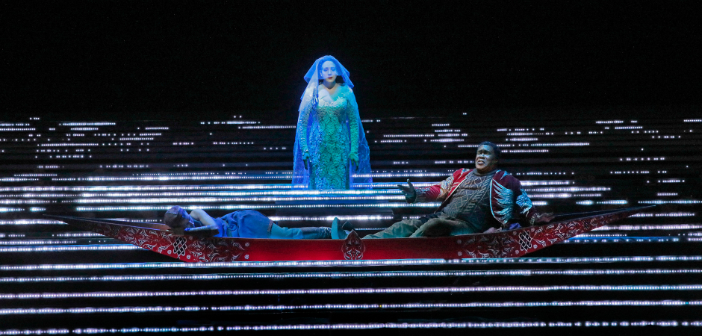
And I mention attention span because L’Amour de loin, I knew going in, was three hours long and had just three characters and a single set – dozens of parallel rows of LED lights and a robotic crane.  I was not sure I could handle it. I struggle to read books anymore but still do, in fits and starts, and I’ve pretty much quit watching movies because I can’t do 90 minutes. I should note, too, that the stakes were somewhat high: It cost $25 to get in (though I had a $5 off gift card from donating blood), which is about a tenth of my weekly income if things are going well. It was not the sort of challenge I would have issued a younger version of myself, when I skydove and walked on building ledges in self-dares, but I am an old man now – 18 months from the senior citizen discount for real – and this seemed like a challenge I’d survive.

Kaija Saariaho is a Finnish composer I play on my Orchestral Maneuvers radio show all the time. She will be all over CC Mixtape #4, by the way, which will draw from Scandinavia. It seems most people who closely follow this sort of music would agree that if she’s not the greatest living producing composer at this point, she’s at least in the top 2 or 3. As a young woman in the ’70s, she had been among a circle of brash and experimental Finns – composers and conductors who pushed boundaries and wove electronics and tapes into their music . Sort of as with David Bowie’s work as he aged, you still hear very noticeably the aesthetic vigor in Saariaho’s present-century work (despite contradictory claims by some detractors who feel she’s gotten predictable…) I’ve come to love her music in much the same way I love the music of her countryman Einojuhani Rautavaara (RIP, 2016) and the Hungarian Gyorgy Ligeti – it’s capable of violent jolts and intense beauty at the same time, ideas sometimes going off like unexpected fireworks in a house fire.  L’Amour de loin (“Love From Afar” is the the translation – despite four years of French in high school, my first thought was it was about a lion and would involve animal costumes) made its Metropolitan Opera debut on December 1, 2016. On Dec. 10 it was broadcast live via closed circuit stream to movie theaters around the world. It was a significant event in its own right – a still fairly vital (born ’52) composer getting the big stage – but significant also due to the fact it was the first opera written by a woman to be performed at the Met in over a century (1903, and then as one-half of a double bill.) And Saariaho’s opera was conducted by a woman, Susanna Mälkki, likewise a Finn and recently established music director of the formidable Helsinki PO. All that’s cool. I like women.

Still, I had my doubts regarding my attention span. I was, moreover, unsure as to whether or not I should smoke marijuana before I went in, in case the idea of sitting among a bunch of white-haired people on a sunny Saturday morning might prompt a quiet, self-contained hysteria once I was in my seat… I took one small puff finally, which was good. I was not bored for one second once the show got going. In fact I was surprised the intermission and end came as soon as they seemed to have.

The whole story aspect of the opera takes place either in a boat crossing the Mediterranean or on balconies overlooking the Mediterranean. The lights were constantly shifting, often to create the illusion of moon- or sunlight, or the reflection of a nighttime port, on water. They achieved a sort of an uncanny super-reality in this respect. It felt like three hours on the sea. But for significant stretches, too, the lights were abstract arrangements of carefully-programmed and shimmering colors – blurs and smears of screeching pink, black-light-poster deep indigo and glowing yellows. The effect of the LED lights in combination with the obliquely beautiful and iridescent shrouds of sound Kaariajo has come to perfect represented the best light show I have ever seen (and I did see the Led Zeppelin laser show at the Columbus Museum of Science and Industry).

The plot itself (the libretto is by Amin Maalouf) is a love story reduced to its barest essence, really, with two strangers and an intermediary, a voyage and a death. The story could be told effectively on stage in a half hour, so the action was not packed and there was a lot of repeated dialogue, a lot of repeated ideas. A lot of repeated dialogue. And a lot of repeated ideas. This contributed to the sort of hypnotic effect the set design and music already achieved. Ultimately, the whole of the production felt like a James Turrell installation, at least what I’d imagine one to feel like based upon pictures in magazines.

All three actors/singers were staggeringly good, and despite my praise for Robert Lepage’s direction and Michael Curry’s set design, that’s the main reason L’Amour de loin was brilliant when all was said and done. No matter what the set looks like or the music sounds like, a weak character in a three-person cast would have sunk it like a cinder block in a diving pool. (There was a sort of Greek chorus that popped up out of the waves from time to time, but they did not constitute a character.) The princess was played by a woman, Susanna Gilbert, who escaped from Alabama and had attended the premiere of the opera in Salzburg with her Mississippian grandmother, and she brought genuine young woman sensuality to the role, sort of in a Kate Bush way. The boatsman was an androgynous character, played here by a woman, who looked sort of like Isabella Rosselini in Blue Velvet. I Google-Imaged her – Tamara Mumford – to see what she looks like normally and it is nothing like her character. The male lead, Eric Owens, suggested an African American Bert Lahr, and he totally sold his character’s foolish – and fatal – longing for a woman he’s only heard of. The brilliant acting of these three – both full-body and facial, owing to the closeup cameras – while simultaneously singing the ridiculously complicated parts seemed, as this music so often does, like a feat of magic to me.

Over the three hours I was periodically reminded it was a live event, experiencing a mild vertiginous awareness each time. The closed circuit cameras used for the broadcast went out every fifteen minutes or so, digitally evaporating into a gray screen with a dot matrix message in the corner, and this reinforced the live event factor in a tension-building way, since you could never be certain if the whole program would cut out.

The theater I saw it in, moreover, was the kind of suburban cineplex where you can see three or four sloshed soft drinks stained onto the screen when a solid color is projected, which continually reminded me I was in a cineplex in North Carolina.

The live factor and the size of the screen (as opposed to that of a laptop, which is how I’d have seen it otherwise) made the price of admission worthwhile. I don’t know if I’ll ever go to another Metropolitan Opera simulcast, mainly because they do not do modern-period works as a rule. There are some 20th C. operas I would pay $25 to see – Bartok’s Bluebeard’s Castle, Janacek’s House of the Dead, and Shostakovich’s Lady Macbeth of Mtensk come immediately to mind – but the Met usually sticks with the stand-by’s, at least if this year’s schedule is indicative of the near future. I don’t really like the music in, say, Wagner or Rossini or Verdi operas too much, just as I don’t really enjoy 19th century and prior symphonic music. But this was $25 well spent.

There is no CD of the L’Amour de loin available for sale, though there is one from Harmonia Mundi available by downloading… 30 tracks at $.89 each or $17.49 for the whole LP on Amazon… I don’t THINK so. I hope someone has the clarity of mind to release this Met production. A live recording would be fine. You can watch a performance on DVD, issued by Deutsche Grammophon in 2005, which features disco-looking sets by Peter Sellars, but I would say, after seeing the Met version, DON’T. You can probably watch the version I saw on the Met site somewhere or other.

One final note: A friend pointed out to me that Saariaho is married to Jean-Baptiste Barriere, a radical electronic composer who began releasing records in the late ’70s and scored a “props opera” by Peter Greenway in ’97. I am listening to an album of his on Youtube right now and it is insane. He and Saariaho have two kids, who must be among the coolest people in the room at any given moment. Youtube, as I often say on my radio show, is a fantastic way to listen to obscure music. It represents the best aspects of the internet, I think. It’s a good way to hear music from Saariaho as well, much of which is out of print or rare and very expensive on Amazon.

I will include links to Alex Ross’s review of the opera from the New Yorker and to the New York Times’ preview of the production, which has information on all the principals.

_______________________________

* It would be good to have a God to believe in if only to shunt some blame His way. As in, “God really fucked up with the opposable thumbs.” Which is true, but where God really fucked up, two major ways, is this: he made reproduction pleasurable – more pleasurable than any other sensation for most people – AND he made our brains too big, to where we understand that we were going to die. What in the F*** was He/She/It (say it fast) thinking on those?!?
http://www.newyorker.com/magazine/2016/10/31/the-oceanic-music-of-kaija-saariaho

Concentration Camp Mixtape #1


00:00:50
Galina Ustvolskaya (USSR, 1919-2006) : Grand Duet for Cello and Piano (1959), 1st movement
Performers: Mistislav Rostropovich (cello) and Alexei Lubimov (piano)
      from Rostropovich: EMI Recordings (box set)

00:03:51
Introduction
Erik Satie (France, 1866-1925) : 42 Vexations (1893)
Performer: Stephane Ginsburgh
      from Erik Satie: 42 Vexations (Sub Rosa, 2009)

00:10:00
Dobrinka Tabakova (Bulgaria/U.K., 1980 – ) : Insight (2002)
Performers: Roman Mints (violin), Maxim Rysanov (viola) and Kristina Blaumane (cello)
      from Dobrinka Tabakova: String Paths (ECM New Series, 2013)

00:19:46
Maurice Ravel (France, 1875-1937) : Piano Trio in A minor (1914), III. Passacaille.
Performers: Borodin Trio
      from Ravel: Trio/Debussy: Sonatas (Chandos, 1986)

00:27:50
Bela Bartok (Hungary, 1881-1945) : Piano Concerto No. 1 (1926), 2nd movement
Performers: Zoltan Kocsis (piano) with the Budapest Festival Orchestra, Ivan Fischer conducting
      from Bartok: Piano Concerto No. 1 and Music for Strings, Percussion and Celesta (Philips, 1985)

00:35:20
Dmitri Shostakovich (USSR, 1906-1975): Piano Trio No. 2 in E, Opus 8 (1944)
Performers: Florestan Trio
from Shostakovich: Piano Trios 1& 2, Seven Romances (Hyperion, 2011)

00:40:53
Alfred Schnittke (USSR, 1934-1998) : String Quartet No. 3 (1983), 1st movement
Performers: Kronos Quartet
      from Schnittke: The Complete String Quartets (Nonesuch, 1998)

00:47:29
Gyorgi Ligeti (Hungary, 1923– 2006): Chamber Concerto for 13 Instruments (1969), 3rd movement
Performers: Schonberg Ensemble conducted by Reinbert de Leeuw
      from: The Ligeti Project I (Alliance, 2001)

00:51:15
Jon Leifs (Iceland, 1899-1968) : String Quartet No. 2, Vita et Mors (1948-51)
Performers: Yggdrasil Quartet
      from: Jon Leifs: The Three String Quartets (BIS, 1994)

01:23:16
Rebecca Clarke (UK, 1886-1979) : “The Donkey” (words by G.K. Chesterton)
Performers: Patricia Wright (soprano) and Kathron Sturrock (piano)
from Cloths of Heaven: Songs & Chamber Works (Guild, 2005)

01:26:32
Pavel Haas (Moravia, 1899-1944) : String Quartet No. 2, “From the Monkey Mountains” (1925)
Performers: Pavel Haas String Quartet, with Colin Currie, percussion
      from Janáček: Intimate Letters/Haas: String Quartet #2 (Supraphon, 2007)


Welcome to the camp…

shostakovichThe aim of Concentration Camp is to be a site where people who are interested in 20th and 21st century “classical” music (a problematic term I’ll discuss later) can read, hear and share things that might be interesting and perhaps even moving to them…

Along with the Mixcloud site of the same name, the hope is to expose as many people as possible to music they might not otherwise get to hear, since most “classical” radio stations rarely play anything beyond a very finite set of modern pieces – “Appalachian Spring,” for example, or Gorecki’s third symphony, much like “classic rock” stations do.  Most orchestras and chamber groups, likewise, shy away from 20th century and 21st century music for their concert programs; typically, modern pieces, if they are played at all, are given the short opening slot on a three-piece bill. As in, “Whew, that’s over, now let’s get to the Mozart.” It’s understandable – most people (or, consumers) have finite storage for music and a finite capacity for dealing with confrontational ideas.

This site is an outgrowth of a radio show I started doing a couple years ago in my town of Asheville, NC. I was offered a two-hour slot and I picked classical as a challenge to myself, since I knew very little about it. I’ve learned a lot in two years, thanks to a lot of reading and listening, but I will remain a novice until the end, I’m afraid. But I have come to love composers like Shostakovich, Schnittke, Saariaho, Ligeti, Ustvolskaya and Ives and believe they should be heard, so I’m going to play them…

For the record, the name “Concentration Camp” is more double entendre than pun. While the historical term lines up neatly with time frame of music that’ll be presented and discussed – the British coined the term in 1901 to describe a tactic employed in the Boer War, where they rounded up and held the families of tenacious insurgents – and while the music I’ll play largely reflects the fact that the 20th C. was a nightmare, the show is as much about listening closely to – concentrating on – music that pays infinite dividends to close listeners. I used to be able to concentrate, but now I have to go to camp to work on it…

Which is too bad. I would suggest that by giving such short shrift to the groundbreaking and extremely fun-to-listen-to music of the 20th and 21st centuries, the classical music establishment writes its own death sentence. Classical music’s audience in the U.S., at least outside of major cities, is wrinkled of skin and silver of hair – a demographic that skews conservative and “safe”. If younger (and “younger” is relative here…) people heard the music from the modern and post-modern eras, I think, that audience might actually grow… Instead, discovering music from the last 120 years requires some work. It’s fun work. I’ll do it.

All anyone needs to know about me or my motivation here is that I was a history and literature teacher for 21 years (and so like the narratives involved in the music) and listening to music has always been the thing I loved best aside from spending time my family and my dogs. And I am a “lay person.” I didn’t start listening to classical music until my mid-50s (I’m 58 now) when I came into possession of two large classical CD collections from people who knew their shit. I sold a lot of the 19th century and prior stuff on Amazon – because, I will admit, it does little for me – but hung on to the modern stuff out of curiosity. And then I started hearing music that BLEW ME AWAY. Psychedelic (for lack of a better word) beyond what I knew possible, music where weird, sometimes subtle and sometimes sweeping melodies are free to take flight and where bludgeoning force and fragile wisps of sound might coexist in the same piece. I think it is the best music ever made by white people.

I think I say out loud at least once a day how lucky I am to have found this music. To consider that I almost passed through life without hearing Arnold Schnittke or Galina Ustvolskaya or Ben Johnston or Einojuhani Rautavaara is staggering to me. These and many other composers have given me a lot to think about at a time – not just in my own old age but within this hyper frantic consumer culture we’re all of us living in – when we need to make sure we keep thinking. The name “Concentration Camp” is a double entendre if that’s not obvious. While the historical term lines up neatly with time frame of music I’ll present – the British coined the term in 1901 to describe a tactic employed in the Boer War, where they rounded up and held the families of tenacious insurgents – the show is about listening closely to – concentrating on – music that pays infinite dividends to close listeners.

While I’m a novice and will undoubtedly make errors, I am trying to make myself an expert – or at least get to the point I can hang in conversations with people whose minds function far more forcefully than mine in these matters – and I will share some incredibly helpful book titles and websites in future posts. And I hope people might write in to, or for, this blog site, so that I might learn from them. I have had inestimable guidance in discovering new music from friends I’ve made via a radio show I do for WSFM 103.3 in Asheville, North Carolina, called “Orchestral Maneuvers” (I needed a name fast), which I also put on Mixcloud. The Concentration Camp mixtapes I’ll put on Mixcloud will be like those shows, only without ads and PSAs and, hopefully, as many mistakes…

A caveat for people who, like I did, approach classical music while rooted in various forms of pop or hook-and-beat driven music: sometimes it takes four or five or six listens to really appreciate or get a piece. It takes a lot more patience than we’re used to. But concentrating pays off. At least for me; hopefully, it will for you as well. hopefully for you, too.

If you want to write for the blog – record and performance reviews would be great! – feel free to contact me at deafmix3@hotmail. Yeah, I’m old.

                                                                                                           Don Howland; Asheville, NC; Jan. 1, 2017