When I was a kid, my dad tried to introduce me to classical music via the usual suspects, most notably Beethoven. The Beatles, Motown, the Stones, Who, Motown and Stax were the soundtrack to my youth – for which I remain eternally grateful – and it was clear after a couple of barely-feigned attempts that I wasn’t budging. Beethoven, Schubert, Mozart and all that sounded like sugary wedding cake – airy and bland – to a 10-year-old in 1968 vis-a-vis “Get Off My Cloud.”
It was not until, maybe 8 years later, I picked up a copy of Béla Bartók’s Concerto for Orchestra (the same Christoph von Dohnányi/Cleveland Orchestra version heard in the mixtape) at the used record store I haunted in my late teens that I heard “classical” music that actually engaged me – classical music that I wanted to hear again as soon as it was over. What I heard, I learned a long time later, were oblique melodies that came from Bartók’s decades of devotion to the folk music of Eastern Europe and northern Africa (the Concerto was written near the end of his life), music he’d internalized and reconfigured into something the world had never heard before. It packed a dramatic wallop, it was catchy, and it opened my mind. Not so different, in those ways, from “Get Off My Cloud” (or, for a timelier reference, “Anarchy in the U.K.”)
Like those of so many transformative artists, Bartók’s career was marked by a stroke of luck, a chance encounter, without which I wouldn’t be here. He was most definitely not, after all, a peasant from the remote mountains of the eastern Slav regions, anymore than Mick Jagger was a black housepainter from Chicago. Bartók, while Hungarian by birth, was raised in a (then-Roumanian) city far closer to Vienna – in every way – than the sticks of Transylvania. Until his mid-20s, Bartók’s familiarity with indigenous folk music did not extend past the incorporation of a few blanched themes in works by Brahms and Liszt. Bartok, in fact, had been composing politely-received music in that same polite Austro-German vein for years.
But upon meeting the charismatic redbeard Zoltán Kodály in 1906, everything changed. Kodály, who was to be a lifelong friend and whom Bartók considered a mentor despite the fact Kodály was a year younger, invited him along on a folk music-hunting expedition. (While Kodály instigated the expedition, he was following in the footsteps of Béla Vikár.) Armed with Edison wax-cylinder phonographs, the duo – and, later, Bartók solo – pursued this fieldwork with hardcore fervor. They went deep. The melodies they encountered in the mountains of Roumania and Transylvania – and that Bartók fastidiously translated (or attempted to translate) into a Western notation system – were grounded in entirely distinct systems, of pentatonic scales and microtonalities, that originated in the steppes of Asia. The line between Eastern Europe and Western Asia, we Americans tend to forget or never learn, is a blurry one at best. (I have included some of Bartok’s earliest wax cylinder recordings at the start of the attached mixtape…) While composers around Europe had been getting below the surface of their regions’ folk musics in the late 19th Century – Edvard Grieg in Norway and Antonin Dvorák in the Czech region come immediately to mind – Kodály and Bartók took it to a whole new level once they started working their revelations into their own compositions.
It can not be emphasized too strongly, then: Bartók’s meeting up with Kodály was SUPER lucky, for both Bartók and for the world of 20th Century art music.* Kodály, while an excellent composer in his own right, probably could not have triggered the seismic shift that Bartók did. With no disrespect to Kodály, Bartók was a giant in terms of his art, a Picasso to Kodály’s Juan Gris, a Charlie Parker to Kodály’s Dexter Gordon. I’m not shooting from the hip here: the writers for the classical record review journals I pour over (the bimonthly American Record Guide is my favorite…) tend to regard Bartók as one of the three foundational pillars of modernist art music, along with Schöenberg and Stravinsky. While those two altered art music formally in important ways (much as Cubist and Expressionist painters did visual art in the same time frame), Bartók was not interested in “the shock of the new.” He was interested, rather, in unlocking what was already there, deep down in the DNA, and with that he produced a flowing, organic music that was freed of any doctrines, including modernist ones.
This playlist is the first of two. I tried to come up with a single 2-hour episode of absolute favorites from Bartók’s extensive repertoire, but I could not whittle it down to under 3 hours. I will put volume 2 up in a week or two. This mixtape is not preoccupied with chronology so much as flow. To that end, I included the first movement from the Concerto for Orchestra as the first example of his mature writing for orchestra, about ten minutes in. That said, many of his later and best-known works will be referenced in volume 2.
As with the mix of Bartók’s “Night Music” a few weeks ago, I generally opted for Hungarian performers for this set. E.g., while there are lots of great versions of Concerto for Orchestra I used the Cleveland Orchestra’s version owing to the facts that A) Dohnányi had Hungarian roots (though born in Berlin) and B) Cleveland was one of two American cities with a Hungarian-language newspaper at the time of its premiere. There are exceptions, nevertheless: Leonard Bernstein, Isaac Stern, Lika Biblishvili, Patricia Kopatchinskaja and the Emerson Quartet aren’t Hungarian (obviously) but their versions of the works included here are, to my mind, the best versions I own. Beauty before geography, in other words.
I have once again used the Hungarian frog sounds where interludes seemed appropriate because I love frog sounds generally, and I have stuck with the Szöllösy index system (of the four indexes that track Bartók’s vast catalogue) for the playlist below. (I have acquired a lot of Szöllösy’s music lately and consider myself at this point a major fan; expect a Szöllösy show soon.)
One final note: I have included two “doors” from 1912 opera Duke Bluebeard’s Castle in this mix. Some Bartók scholars consider that opera, his lone foray into the genre, his first mature work for orchestra – one where he synthesizes the parallel universe folk music he was fieldrecording as well as the liberating innovations of Debussy within the conventions of Austro-German orchestration. But I just wanted to recommend Bluebeard’s Castle to those out there who (like me) really struggle with opera.It is just an hour long, has only two characters, and tells a twisted tale that resonates – haunts, really – on multiple levels. Mostly, it’s just brilliant music. It and Shostakovich’s Lady MacBeth of the Mtesnk District are two operas worth owning…
I digress; with no further ado, then:
0:00 CC Theme Song
0:01:28 Various: Roumanian & Hungarian Folk Songs Field recordings by Bartók, 1906-1907
0:04:19 Bartók: Roumanian Folk Dances, SZ 56 (1915) – 1. Stick Dance Zoltán Kocsis (Philips)
0:05:27 Bartók: Rhapsody No. 1 for Violin and Piano, Sz. 86 (1928) – I. Lassú; Moderato Piotr (v) & Monika Wilinska (p) Tarcholik (CD Accord, Poland)
0:09:43 Bartók: Concerto For Orchestra, SZ 116 (1942, rev. 1945) – I. Introduzione Christoph Von Dohnányi: Cleveland Orchestra (London)
0:20:23 Bartók: Piano Concerto No.1, SZ 83 (1926) – 2. Adagio Zoltán Kocsis w/ Iván Fischer: Budapest Festival Orchestra (Philips)
0:27:28 Bartók: String Quartet #2 In A Minor, SZ 67 (1915-7) – 2. Allegro Molto Capriccioso Emerson Quartet (Deutsche Grammophon)
0:34:45 Bartók: Etudes, Sz. 72, Nr. 3 (1918) Lika Bibileishvili
0:36:59 Bartok – Violin Concerto No. 2, Sz. 112 (1938) – I. Allegro non troppo Patricia Kopatchinskaja w/ Peter Eötvos: Frankfurt Radio SO (Naive)
0:54:00 Bartók: Bluebeard’s Castle, SZ 48 (1912, rev. 1917) – Door 4: Oh! Virágok! Oh! Ilatoskert! & Door 5: Ah!; Lásdez Az Én Birodalmam Olga Szönyi & Muhaly Székely; Antal Doráti: London SO (London)
0:59:53 Bartók: String Quartet No. 3, SZ 85 (1927) – 2. Seconda Parte Takács Quartet (London)
1:09:47 Bartók: Music For Strings, Percussion & Celesta, SZ 106 (1936) – 3. Adagio Zoltán Kocsis w/ Iván Fischer: Budapest Festival Orchestra (Philips)
1:17:27 Bartók: Rhapsody #2, SZ 90 (1928, rev. 1944) – 1. Lassú Isaac Stern w/ Leonard Bernstein: New York PO (Sony)
1:22:08 Bartók: Dance Suite (Táncszvit), Sz. 77 (1923) – 4. Molto Tranquillo Adám Fischer: Hungarian State SO (Nimbus)
1:26:08 Bartók: Miraculous Mandarin, Op. 19, SZ 73 (1918, completed 1926) – 1. Allegro, Curtain Antal Doráti: Detroit SO (Decca)
1:32:33 Bartók: Hungarian Pictures, Sz. 97 (1931) – 1. Evening In Transylvania Adám Fischer: Hungarian State SO (Philips)
____________________________
* To get an idea of what Bartók’s career might have been like had this transformative relationship never happened, you can listen to pieces like his Piano Quintet in C major from 1903. Or, perhaps more instructive still, you could look at the career and legacy of the Hungarian composer Bartók emulated growing up, Ernö Dohnányi. Dohnányi (Christoph’s father) was not averse to working some folk-lite melodies into his compositions, many of which have stood the test of time despite their wallpaper-paste texture and flavor. Dohnányi – who altered his name to “Ernst von” to make it sound German – made no waves whatsoever…
I had not taken anything like a “vacation” since 2012 when, in January, I plunked down some serious (or, more to the point, seriously scarce) digi-dollars on a round-trip flight to Minnesota, a couple tickets to see the Minnesota Orchestra, and four nights in a hotel.
I have to move out of the trumpf-ass south (I can not dignify either with a capital letter) and have thought Minnesota might be my best bet. My initial thought was to move to Ilhan Omar’s district in Minneapolis, and I still may, but the state more broadly has the longest run of any in terms of voting for democrats in presidential elections without a miss. I despise the democratic party for many reasons, but republicans are worse. (I can not dignify either with a capital letter.) The christian (ditto) fascist wing – more like the whole vulture at this point – egged on by the super-rich, is trying to jumpstart Armageddon. They are. They say so. Why can’t we just be open about what is obviously true? They want to take 30 million people’s health insurance away and replace it with nothing. They want to take away women’s right to choose their futures. F republicans and the southern and midwestern states that enable them.
I digress.
Checking out neighborhoods in a city 800 miles away (or so) is not easy when you’re poor. I needed a substantial carrot to poke me out of inertia, and thought perhaps the Minnesota Orchestra might provide one. When I checked their 2019-20 concert slate online last September, sure enough, I was presented with one:
March 5 & 6, 2020 Kiril Karabits, conductor, & Christian Tetzlaff, violin Franghiz Ali-Zadeh: Nagillar (Fairy Tales) Shostakovich: Violin Concerto No. 2 in C-sharp minor, Op. 129 Intermission Prokofiev: Symphony No. 5 in B-flat major, Op. 100
Tetzlaff, a contemporary superstar, at least in the classical music sense of the term, playing the infrequently-programmed Shostakovich 2nd violin concerto from 1967 under Karabits, a Ukrainian rising star, along with an unfamiliar Ali-Zadeh piece, would make a March trip worth it, I thought, but by the time the “holidays” rolled around I was feeling broke and had just about talked myself out of it… until I saw the docket for the same weekend’s Saturday night all-Russian program, which somehow I’d missed. The bill for that show was as follows:
March 7, 2020 Mussorgsky (orch. Ravel): Three selections from Pictures at an Exhibition Kabalevsky: Overture to Colas Breugnon, Op. 24 Gliere: Introduction from The Zaporozhy Cossacks Ustvolskaya: Symphonic Poem No. 2 Shostakovich: Two Pieces for String Octet, Op. 11 Intermission Shostakovich: Allegro from Symphony No. 10 in E minor, Op. 93 Prokofiev: Allegro from Symphony No. 5 in B-flat major, Op. 100 Gubaidulina: Movement VI from Stimmen… versummen Lera Auerbach: Icarus Polina Nazaykinskaya: My Soul Craves for the Sky
This program was to be conducted by the orchestra’s assistant conductor, Sarah Hicks.
More Shostakovich was cool enough, but Ustvolskaya, Gubaidulina and Auerbach are three composers whom I love– I have devoted entire radio shows to each of the three – but whose works I never thought I’d hear live. I bought tickets to both shows immediately, before I could change my mind.
What follows is an account of those two concerts, along with a little context. The attached mixtape is some of the music I heard, though by different orchestras…
************************************************************* March 5, 2020
I’d arrived the night before and hoofed the six blocks, head down, in a cold rain. In the morning’s grey light, Minneapolis is as clean and open-feeling as any city I’ve been to in Europe or the United States. The newer architecture is for the most part compelling and artful, in stark contrast to other U.S. cities that did a crapload of building in the ’90s and aughts like, oh, Columbus, Charlotte, Houston, Nashville, Houston… and wound up with a crapload of aura-free mega-tombstones.
As I neared Orchestra Hall, I saw Christian Tetzlaff walking down the sidewalk. One of the many – almost infinite – things I like about classical music vis-a-vis other genres is the scale. A veritable superstar walking alone – no limo, no assistant, let alone an entourage – to the hall. It’s kind of like bluegrass in that sense. I’m a fan – his recording of Bartok violin concertos for Ondine was phenomenal (it won Grammophone magazine’s album of the year in 2018) – and so that necessitated the blurt and the ensuing awkward exchange, though once he realized I was a fan and not a homeless guy (at least not yet), it was cool. (I have found, in general, classical musicians are not really used to the rock and roll enthusiasm thing, but don’t mind it once they’re clear it’s not malevolent or deranged…)
Minneapolis’s Orchestra Hall was built in 1974 (and given an overhaul in the meantime), and it is sharp. Constructivist in a glass-and-steel way, it epitomizes the best architecture of the time. Which is to say it looks Scandinavian. Inside, the hall is long and very tall, with the balconies high along the walls like ledges over a chasm. Acoustically it is magnificent (to my blown-out eardrums, at any rate), with huge prismatic protuberances emerging from the high wall behind the orchestra and suspended from the ceiling that probably serve to direct the sound but also look cool as hell (in a ’74 way), lit (most often) in pastel shades of purple and orange. It felt good in there.
A quick leaf through the program before the lights dimmed revealed no less than 13 programs in the Minnesota Orchestra’s 2019-2020 season I would have attended had I lived there. Lead conducter Osmo Vänskä, who has helmed the orchestra for years and will be retiring after next season, regularly programs fellow Finns Einojuhani Rautavaara and Kaija Saariaho, along with plenty of other 20th C. composers.
I am a fan of the Azerbaijani composer Ali-Zadeh and have played her works on my radio show many times, but the piece on this program was fifteen minutes long and did little, it seemed to me, beyond establishing a sound cloud, peppered with flecks of melody that never went anywhere, for a long time. It hovered. The sounds were exotic-y: a vibraphone, glass chimes, all sorts of bells, a piano with a glass-beaded necklace laid over its strings. It came together in the final two minutes in a beautiful sort of crescendo, with a fully-drawn melody – a corker, it was – for an old jackass to hang his cap on. There was but faint (if any) suggestion of the Caspian Sea in the piece that I could detect, which surprised me. The stuff of hers I’d heard going in – including her work with the Kronos Quartet, with whom she played piano for a brilliant quintet called “Aspheron” – is based around mugam – South Asian folk, in other words – forms. Many composers, starting with Bartok, have internalized their region’s ancient musics and created new kinds of music with them; Ali-Zadeh is one such. So maybe a little disappointing, but fine… Again, it was 11:00 in the morning – who knows how I’d have regarded it at 10:00 p.m. Not to mention the fact that it was a first hearing. To be honest, I am reluctant to comment on any piece I’ve heard only once. Many, perhaps most, of my favorite compositions didn’t do a whole lot for me the first time around. So…
Tetzlaff was up next. I only have a couple recordings of Shostakovich’s second violin concerto, but the one I always play is of David Oistrakh with the Moscow Philharmonic under Gennady Rozhdestvensky. Oistrakh was, like Rostropovich and Vishnevskaya, a part of Shostakovich’s circle in the Soviet ’50s and ’60s; Shostakovich wrote the piece for Oistrakh’s 60th birthday (even though he was off by a year – Shostakovich gave him a violin sonata the next year for his actual 60th). Tetzlaff himself recorded a version in 2014 for the Finnish Ondine label that I hadn’t heard (I have since; it is included on the accompanying mixtape). The second concerto is rarely performed because it is quite difficult, even for virtuosos. It’s difficult for audiences as well – it is at times relentlessly brutal and at others relentlessly bleak. NOT music to snuggle to, let’s say. It is also profoundly beautiful in its way, among the greatest works of Shostakovich’s staggeringly fruitful life.
It begins with a murmur of strings, then the violin intones that theme Shostakovich employed often, except that it won’t resolve, creating a vague, immediate tension. The overall vibe of the piece, it develops, is one of tension. Snare shots pop like gunshots throughout a jostling first movement, while giddy – ironic, undoubtedly – themes are taken up and but then trip over their laces and fall, while the soloist contributes some hard – Bartok-hard – pizzicato *thwapping*. Time and again, the violin re-ups the familiar opening theme, but it starts warping out of shape. About five minutes in, the listener begins to suspect – correctly – that the theme WON’T be resolved. And then… the first movement just cuts off. Boof. Like a plug pulled on a radio. Like an old man having an aneurysm in a crosswalk.
Concertos are my favorite form of orchestral composition because they portray the individual’s relationship with and struggle against the much more powerful forces that have the final say, and no composer explored the existential aspect of the form like Shostakovich. There is a lot of direct conversing between the soloist and the orchestra in the second and third movements (which flow together to the extent I actually thought it was a two-movement piece until I saw it written down…) I suspect it’s no coincidence that Shostakovich wrote his stunning soundtrack for the Soviet version of Hamlet (1966, d. Grigori Kozintsev) in the same time frame. As in the play, the violinist is given a soliloquy very near the end that is pure strife and insanely difficult, and Tetzlaff leaned into it, dazzling the crowd.
I recently read review of a Tetzlaff recording – I can’t remember of what – that, by way of praise, described his playing as “creamy.” That is not a word I’d use in a positive context, but I see what the writer was getting at. Maybe “Germanic.” Tetzlaff is a German and you can tell. He strives for beauty over angst. Here, he rounded the edges somewhat, sacrificing a bit of anguish. But as with his take on the Bartok 2nd concerto, he presents a dimension to the piece I hadn’t considered before. My guess is Shostakovich, who revered Mahler, would have liked it as much as I, and the audience, liked it.
Tetzlaff gets a Standing-O
Prokofiev’s 5th symphony is considered by most the best of his seven. It’s definitely the most meaning-laden. It was written in a single month in 1944 while the Nazis fought frantically for a toehold in their 3-year and 3-pronged attack on the USSR, and it was first performed in Moscow on the very night heavy Russian guns – audible inside the hall to the extent that Prokofiev, who was conducting, paused the performance – signaled the turn of the war: the Nazis were in panicked retreat from Moscow, with the Soviets, hellbent on revenge, hot on their heels. That is some serious coincidental drama right there. It is a great symphony that doesn’t do all that much for me. (I dig some Prokofiev immensely but, unfortunately for him, he did not outlive Stalin, and this symphony is not unlike the Shostakovich symphonies (nos. 5-9) written in the Stalin years – booming and brash but not challenging or, more to the point, honest.) I thoroughly enjoyed watching the orchestra perform it, however. I think I am ready to start going to concerts of music I don’t necessarily like all that much ahead of time. Live classical music is like a great magic act to me. I feel disbelief when I watch 80 or 90 intent and deeply-skilled humans in perfect synchronicity translating a composer’s abstract notation into sound and – with the right conductor – meaning. For someone who grew up with electric guitar music, the fact that the instruments are acoustic, fashioned by hand from wood and metal, is something I’m always conscious of. It’s like I’m like a caveman ogling an obelisk from 1 million years in the future. Or past. It’s a good feeling. It’s called awe.
The Russian program on Saturday night was pretty much what I hope the afterlife is like.
Orchestra Hall, Minneapolis
The first mind-blowing aspect of the evening hit me the moment I entered the lobby.* It was the crowd itself. The matinee I attended two days before played to a sea of white and grey heads. But this Saturday night audience was so diverse it was disorienting. TONS of people in their twenties and thirties. And forties and fifties. And teens. High school kids on dates. And not only that: there was a diversity I never imagined in a 21st century concert hall. There were black people, Arabic people, Asians all over… whole families with kids…
Once in the hall, I regretted leaving my phone in the hotel; the back wall was lit in a brilliant, CCCP-flag red…
The Sam and Sarah programs the MO does are kind of “edutainment” – about 20% educational and 80% music, I gather. The hosts introduce the pieces and the context in 2-5 minute talks. Both Mr. Bergman (a violist in the orchestra) and Ms. Hicks are very agreeable presenters – natural, good-humored, rehearsed – and their intros were insightful and tight. Though they were introducing pieces by composers who are rarely heard in U.S. concert halls, there was no coaxing or condescension towards the audience. I suppose that’s what living in a city where there’s an actual audience for classical music is like. People who don’t need to be told who Kabalevsky is, e.g.
The program, as was apparent at first glance, was designed to tell the story of Russian music in the modern era, an undertaking that requires some thought. Apart from no Schnittke, I have to comend Sam and Sarah for their choices.
Mussorgsky was one of the “Mighty Five” composers in the late 19th C. who, more than their contemporary Tchaikovsky, established a distinctly Russian brand of of classical music. He was Shostakovich’s favorite Russian composer of the 19th C. The two excerpts from his “Pictures at an Exhibition” – or, rather, from Ravel’s 50 years post-facto orchestrated version – did not include that familiar hallway theme forever soiled by Emerson, Lake and Palmer’s Moog-synthesized schmaltz. They were cool, but over before I had really settled in, and I’m really only familiar with the original solo piano version.
Kabalevsky and Gliere, up next, are two composers I avoid – especially Kabalevsky, who worked as a sort of censor on behalf of Stalin’s vision of “socialist realism” – but the pieces chosen for this evening were actually a lot of fun, and forceful, to an extent undercutting Mr. Bergman’s point that the two composers were toe-the-line hacks… Which set up his intro to the next piece, by an iconoclast who created music so weird that it must’ve confounded the censors…
I felt tears well up in my left eye during Bergman’s Ustvolskaya intro. To hear her praised for the genius she was, before an attentive crowd that would roar its approval twelve minutes later..? Never thought I’d live to see it. Ustvolskaya’s best music is too harsh for even me to listen to all the time, but it’s there when I need it, and I need it often enough. The choice of her Poem No. 2 (as opposed to Poems 1 or 3) shows that Sam and/or Sarah know their Ustvolskaya – it is the one fairly conventional 1950s work that presaged her later SLEDGEHAMMER works of the 1960s. More to the point, it is her only early work that deserves a place among her greatest works. I wasn’t super familiar with the Poem No. 2 until the 2-CD set of her early works that came out on Brilliant Classics last year. The set, which comprised early stuff that, by and large, Ustvolskaya dismissed when compiling her opus list. No. 2 was by far the best track on that set, but its real genius eluded me until I saw and heard Hicks lead the MO in a driving version. I mean, it throbbed! DAMN!
The choreographed exit of musicians from the stage after the Ustvolskaya piece to set up the Shostakovich pieces for octet that came next was a nice touch. When the first musician, a member of the violin section, got up, I thought she must have broken a string or something. Then another got up, then another… All the while the lights dimmed and the red deepened; Bergman, while this went on around him, told about Stalin’s approach to governing, which – short version – was to assassinate any perceived foe. (That Monty Python Stalin gameshow gag was actually pretty much how it would’ve gone down…) When his remarks concluded, Bergman joined three other violas, two violins and two cellos in a standing horseshoe to play the two short pieces from Shostakovich’s youth against a blood red backdrop, almost in the dark. The ambiance lent a weight to the pieces – early ones, by a still-optimistic Shostakovich – that aided the transition from the Ustvolskaya.
During the intermission that followed, I walked around the multi-tiered lobby, taking in the warmth and lively chatter of a bunch of different types of people enjoying themselves. I took a few minutes to check out some display cases filled with memorabilia from the orchestra’s 117-year history on the second floor level. The orchestra has had some great conductors over that time, including Neville Marriner, Edo de Waart, and the Hungarian maestros Eugene Ormandy and Antal Dorati (who, according to his auobiography, loved his time in Minnesota and recorded a series of programs for Mercury Living Presence that remain the sine qua non for classical music on vinyl and still go for $$$ on Discogs). Besides Dorati’s, the orchestra has a vast number of recordings – 107, according to Discogs. (Vänskä‘s highly-acclaimed Sibelius and Mahler series, on the Swedish BIS label, are for sale in the lobby.) On the wall behind the display cases, the orchestra presents framed color 8x10s of each current orchestra musicians in a long row. Starting from the far left with Vänskä, I was again struck by the sheer number of women in positions of power. Five of the top seven positions – concertmaster, principal violinist, principal violist – are held by women. Another reason I love classical music is because women, at least in the present tense, enjoy equal status to men.
The movement from Shostakovich’s 10th symphony, which many consider his greatest symphony, dates from 1953, the year Stalin “gifted” the world with his death. It is a symphony I only recently listened to closely for the first time. It is easily the best of the Stalin years, I’ll say that. This allegro movement was as exuberant as Shostakovich got, at least since his fourth symphony. Very powerful in the live setting.
The Gubaidulina excerpt was from 1986, the period when “Thaw” (or post-Stalin) composers like Schnittke and Part established themselves as part of a new mainstream. Stimmen… Verstumen, a symphony in twelve movements,is one of her best, and while I’d like to have heard the full 34 minutes or at least the 11-minute eighth movement, the movement chosen was a ridiculously beautiful five minutes. It incorporates a piano and an electric keyboard and achieves max sublimity.
Lera Auerbach, next on the docket, represented the composers who attained maturity as the USSR was, like the uber-metaphorical Chernobyl, imploding. Auerbach defected – part of the last generation for whom “defect” was an action verb – to the United States while on a trip in her late teens, and she has developed into one of our (meaning, the world’s) great composers. (Why so little of her orchestral music is available on disc, especially in light of how good the stuff that has been recorded is… BIS?) Her Icarus is also the last two movements of her first symphony, from 2006. it begins full throttle and evolves into a haunting shimmer, finishing with a percussionist ringing a water-filled wine glass……………….(………….)
Polina Nazaykinskaya, composer of the 4-minute song that concluded the 2-hour show, was born on the lower Volga in ’87 and now resides in NYC. The full title of the piece (on Nazaykinskaya’s Youtube channel) calls for a “folk singer”, and the vocalist this evening was a young woman named Natalie Nowytski, a specialist in Eastern European repertoire. (The program notes say she has sung in 50 different languages, which certainly makes me feel like a mental midget…) A Ukraine native now based in the Twin Cities, she is a powerfully-built woman with the pipes to lift her voice over a couple dozen musicians directly behind her. Her approach lent the piece a folk music vibe; with sparer backing, it would have passed for a Russian folk song. It was fine, and I hoped they’d do another with her for an encore, but, alas, no such luck.
(Four of the nine composers on that program were women, in case you hadn’t noticed.)
Like all orchestras trying to stay afloat in a time when the vast number of people don’t care about art, they do a lot of audience-friendly stuff, like playing movie scores. Tonight, Sam and Sarah told those who could wait ten or fifteen minutes for the stage to be cleared that they and a number of musicians would return to the stage for a meet-and-greet. I was probably euphoric enough that I’d likely have provoked more discomfort; luckily for them, then, that I had an early flight to catch the next morning, and Daylight Savings Time was casting its long and utterly pointless shadow…
(Can this be the last time we do DST? Please?)
Finally, it has not been lost on me how lucky I was with this trip, vis-a-vis the pandemic that we’re contending with now. Had those shows been scheduled just one weekend later, I’d have been SOL. While there are times I wonder if everything is just an illusion, I am not so self-centered as to think anything is pre-ordained. But I am grateful for good luck when it arises. I wish anyone reading this the best of luck in the weeks and months ahead. It looks like there’ll be time for some concentrated listening, at least.
____
Dmitri Shostakovich (1906-1975) Violin Concerto No. 2 in C-sharp minor, Op. 129; I. Moderato (1967) Christian Tetzlaff w/ John Storgårds: Helsinki PO (Ondine) ____
Galina Ustvolskaya (1919-2006) Poem No. 2, “Hero’s Exploit” (1957) Igor Borisoglebsky: Leningrad Radio Youth Symphony Orchestra (Brilliant Classics) ____
Sofia Gubaidulina (1931- ) Stimmen… verstummen (Voices… silence) (1986); VI. Gennady Rozhdestvensky: Royal Stockholm PO (Chandos) ____
“Night Music” is a term the Hungarian super-genius Béla Bartók (1881-1945) used to describe passages and sometimes entire movements in his works. There’s not a strict technical definition for “Night Music”; rather, it describes a vibe he was going for, specifically the feel of nature at night, when frogs and cicadas and owls let loose, and breezes hum through the trees. More simply put, “Night Music” describes some of his eeriest music. He began with this concept early on – the first piece here dates to 1908 – when he first emerged from his youthful Debussy and R. Strauss worship to become a distinctive voice. I would refer you to an excellent overview of the subject on Wikipedia (and while there, consider perhaps a donation to the site, one of the few non-malignant sites on the sh*t stream that is the internet…) This mixtape is, to a large extent, based on that Wikipedia entry.
Real quick: there are three different indexes of Bartok’s many compositions created by musicologists. In addition, Bartok himself assigned his works opus numbers; however, he started his listings three different times. It’s super confusing. A lot of recordings use none of the designations, which makes things even more confusing. I went with the Szőllősy index (Sz.) because it seems to be the most accepted index and because András Szőllősy was a fine composer in his own right. I also went with Hungarian performers and conductors wherever possible. A couple of these pieces are ridiculously underrepresented on in-print CDs. The Sonata for Two Pianos and Percussion especially…
The frogs you’ll hear here between tracks ARE Hungarian, btw. Hungaroton issued a whole LP of different Hungarian frog calls!
0:01:43 Out of Doors (Sz. 81, 1926), No. 4: The Night’s Music Dénes Várjon (ECM New Series)
0:08:07 Dance Suite (Sz. 77, 1923); II. Allegro Molto Adám Fischer: Hungarian State Symphony Orchestra (Nimbus)
0:11:58 Bartók: String Quartet No. 3 (Sz. 85, 1927); I. Prima Parte Takács Quartet (London)
0:16:55 Bartók: Piano Concerto #1 (Sz. 83, 1926); II. Adagio Zoltán Kocsis; Iván Fischer: Budapest Festival Orchestra (Philips)
0:24:17 Bartók: 15 Hungarian Peasant Songs (Sz. 71, 1914-18); No. 3. Poco rubato Jenő Jandó(Naxos)
0:25:12 Bartók: Sonata for 2 Pianos and Percussion (Sz. 110, 1937); II. Lento ma non troppo Chamber Music Society of Lincoln Center (Delos)
I love saying ” Knudåge Riisager.” According to one of the on-line pronunciation services, Danes pronounce it “kuh-noy-DYE rrREES-ayah.” I hope that’s close to right, because that’s how I’m gonna keep on pronouncing it. It makes me feel better. Kuh-noy-DYE.
I feel like I did Riisager a bad turn last year when I did a less-than-perfect (in terms of choices) 2-hour OM episode highlighting his work. The mix below is much closer to perfect. In his day, Riisager was an outsider in Denmark and Europe, along the lines of Charles Ives or Wallace Stevens here in the U.S. in that same timeframe. Like those two super-genius Americans, Riisager worked in the white collar world as a comfortably-compensated executive and thus was free to ignore or adopt/adapt whatever happened to be in style at any particular moment. He was likewise free to write for unusual instrumental combinations (see Variations below), producing unique sonoric mini-worlds.
For those wary of off-putting and oblique music, Riisager’s is immediately engaging, reflecting to a degree influences like Ravel and the accessible neoclassical Stravinsky. At the same time, it obviously comes from a different place, a parallel dimension much like ours but with subtle and significant differences. While some of his youtful pieces from the 1920s could have been considered avant-garde – the tone poem T-DOXC (a once cutting-edge airplane) is considered a “Futurist” work – his music eschews confrontation. Exceedingly tuneful and adventurous, the correlation in rock music terms might be Syd Barret-era Pink Floyd or pre-Tommy Who – wry art pop that could be sunny and vigorous or melancholic and bittersweet.
Also along those lines, many of Riisager’s pieces are composed of short, pop song-length episodes – he wrote a lot for ballet, which lends itself to that – thereby providing easy (or easier) entry for people (like me) whose attention spans and ability to focus have been deeeeeeeeeply compromised by the incessant discord of 21st C. life. There are 19 tracks on this 103-minute mix, to wit.
Classical fans who like the composers I cited above as influences, or who like hook-filled neoclassical Prokofiev (e.g. the Lt. Kije Suite),will likewise find much to like in Riisager’s output.
Riisager’s was a distinct voice, at once complex and inviting. He’s the sort of composer who should have been and could still be “popular” (by classical music standards) IF his music reached an audience. It’s a real shame he is virtually unknown. That’s why I do this blog thing.
I believe every track on this mix is sourced from a Dacapo release. [Dacapo: Denmark as Chandos: England or BIS: Sweden.] There are few Riisager pieces that have been recorded by more than one artist, so you will note a lot of the same names on the playlist below.
I could cut and paste the opening line of my “Year in Review” posts, or at least the first half of it: 20__ SUCKED on the macro level, but…
…it was, nevertheless a good year for modern-era classical music.
Again, I spent the entire f’ing year in a sort of low-grade shock as I watched our racist, misogynist and imbecilic head of state thrash about incessantly, his motivations (his fanboy love of Putin, his never-checked egomania, and his brazen contempt for all those in the 99% who don’t support him) flashing in 50 ft.-high neon like the street-facing side of a 2-bit casino.
And again, three things kept me afloat: hiking in the woods, reading, and this music. About hiking nothing needs be said, although Scott Power’s Pulitzer Prize-winning tree-centric novel The Overstory did enhance my already-deep appreciation for nature (which is boundless.) The other books I read of the non-musicological variety were mostly ones that chronicled the rise of fascism in mid-century Europe, just so the eerie parallels in our time would never stray too far from my consciousness. The music, like my hikes in the nearby national forest, is a mostly abstract experience, and I will say again that listening – or even trying to listen – to 10- or 15- or 30-minute pieces is restorative, a form of meditation. I feel incredibly lucky to have found this music.
So here are my favorite things from the past year.
1) Women.
I don’t agree with 2020 Obama on much, but I do agree with his recent assertion that women make, or at least would make, much better rulers than men, both temperamentally and intellectually.
I find myself, increasingly, gravitating to women composers these days. It no doubt reflects some deeper need in this age of trump. To be sure, I’ve sought out women composers since I got the slot – featured Composers-of-the-Month over the years have included Rebecca Clarke, Grazyna Bacewicz, Ustvolskaya (thrice), Gubaidulina, Gloria Coates (twice), Kaija Saariaho, Anna Thorvaldsdottir, Johanna Beyer and Ruth Crawford, Nina C. Young, and Lera Auerbach. But now I’m sort of getting to where I ONLY want to hear women.
Luckily, women composers are no longer considered novelties, and artists and labels are working hard to rectify the neglect women composers of yore experienced and to present vital music by contemporary women composers. There were enough great releases by contemporary women last year, in fact, that I devoted an entire mixtape to them:
2) NMC Recordings
NMC is a “charity” or “co-op” label in England, which means they’re funded by grants. NMC promotes U.K. composers from all corners, including Australia. There are a lot of interesting composers active in England – it would seem to have the greatest concentration of young and younger talent of any place in the world, if you were to judge based on NMC’s back catalogue. It features avant-garde heavyweights like Birtwistle, Ferneyhough, Maconchy, and Lutyens but also young or younger composers like Joe Cutler and Joanna Bailie and a whole lot more… Maybe that’s just the sort of illusion a colorful, for-the-people label can create, but I think not. The website is nmcrec.co.uk and has some handy interactive tools for identifying composers you might like. I’d suggest starting with the music of Joanna Bailie or Joe Cutler. You can refer to this Mixtape and the playlist that goes with it:
3) German & Austrian Composers
I realized when I started this project of re-wiring my brain that I would have to limit the scope of my exploring because, quite simply, I am too old to take on the breadth of contemporary art music. I realized that four years ago, before I had any idea how much truly brilliant music is out there. There’s too much worth hearing.
So I set some parameters that I’ve followed generally, which exclude substantial chunks of what most would consider the essential repertoire of the “modern” period as I define it (1880-present). If one was to scroll through the four years of playlists for the radio show I do on WSFM in Asheville, she or her would notice a relative dearth of works by either German or American male composers. The reason for these exclusions is simple: the histories of the two countries across the time period I cover are despicable. (I generally exempt women from blame for past events, unless it’s, say, Hillary Clinton in 2016 not campaigning in Pennsylvania or Wisconsin.)
This year I finally got around to acknowledging the absurdity of that parameter. Artists are not responsible for their nations’ evil deeds. Should I hate Aaron Copland or Missy Mazzoli because they lived through decades of blatantly evil U.S. foreign policy?
For me, that meant I had to check out Schoenberg and cohorts. Part of my no-Kraut rule was that I’d never heard anything by the “Second Viennese School” that moved me. Four years of listening to complex music has apparently loosened me up. Schoenberg, Berg, Webern, Wellesz – all of them wrote fantastic music.
Webern, I should add, apparently was pro-Nazi, and that took some rationalizing on my part, because I am so repelled by what I know of the Nazis (and I have read way too much), I would have voted to incinerate the country and all of its inhabitants after WWII. Without even thinking about it. Webern’s orchestral music, on a CD from Naxos with a Japanese conductor leading an Irish chamber orchestra (the sort of thing that makes Naxos so cool.) The record struck me as sharing a stark and dark vibe with Joy Division’s first album. Which is to say, it rocks.
The other German composers I listened to for the first time in 2019 and loved were two mid-century men – Karl Amadeus Hartmann and Bernd Alois Zimmermann – and then Karl Werner Henze, a radical Leftist (which meant something in the Baader-Meinhoff days…) who was writing great work at the same time the Russian Thaw composers were emerging in the U.S.S.R. I am just starting out with these guys, so I don’t feel comfortable saying much beyond the fact I heard pieces by all three I really liked last year.
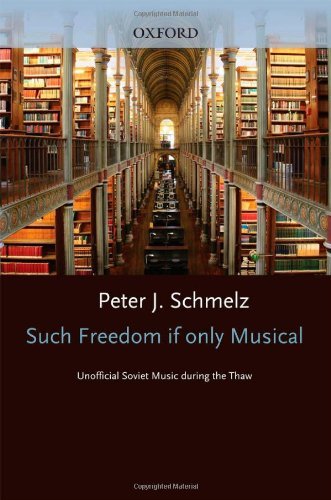
4.) Books by Peter Schmelz: Such Freedom (if only musical) and Alfred Schnittke’s
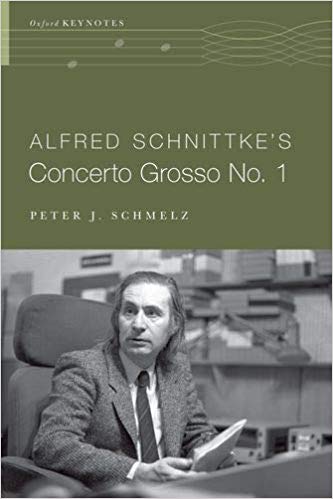
Concerto Grosso No. 1
Schmelz is a (soon-to-be full) professor of musicology at Arizona State. He has had two books published to date, both on Oxford University Press and both of them on a fascinating era of Soviet music, the period in the immediate aftermath of Stalin’s death, when young composers like Schnittke, Part, Gubaidulina, Tishchenko, and Denisov (among others) were in Conservatories and suddenly freed to experiment. The period was and is referred to as the Thaw. To my way of listening, that Thaw period (which began icing back up in short order after Khruschev was succeeded by Breshnev as the head of government) ultimately represented the greatest concentration of genius the post-war music world has ever seen.
Schmelz’s first book is an overview of the Thaw, titled Such Freedom. Schmelz, in an email response to one I’d sent delineating my difficulty in locating a copy, suggested Such Freedom might be difficult for a non-academic and that his more recent book on Schnittke’s Concerto Grosso No. 1 was directed at a broader audience, but I beg to differ. Schmelz is a good-enough writer (not super common in academe) that he can engage “lay” people like myself in addition to academics. Both books tell stories, for one thing, and are very easy to follow – even for those of us for whom pages of scores are, in effect, blank.
The way Schmelz tells it, the Soviet Thaw reminds me of jazz scenes I’d read about, like the Beboppers in the 1950s or the free jazz loft parties described in Leroi Jones/Amira Baraka’s books. Or even the rock scenes in mid-’70s NYC and the U.K. I will be devoting an OM show or two to the Thaw period this winter, including excerpts from an interview I did with Schmelz, who is a very gracious and affable guy. I found a copy of Such Freedom on Biblio for $25 so don’t despair like I did if you see prices three and four times that on amazon. F*** amazon, anyway!
The Schnittke book, which reminds me of that series of rock and roll books devoted to a single important album, in the way it weaves history and biography into a consideration of one piece. It is recent and available for cover price, at least.
I’m doing a Thaw CC Mixtape. It’ll give an idea of what was going on in Russia from ’55 to ’70 or so. Famous people and some I’d not encountered before.
5) Brick and mortar record stores.
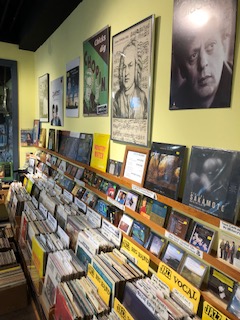
Or, in my case, store, singular. I am the sort of person who hung out in record stores for many years, until I was around 40. It’s easy enough – even still – to find stores with most genres of music stocked to the gills, but there are not many stores, used or new, that maintain a good-sized classical inventory. I found one this year, and it reminded me of how much fun it is to dig through stacks and talk w/ proprietors who know their shit.
The store I found is Horizon Records in Greenville, SC. Ryan at Harvest here in Asheville (which has a small bin with a nice selection of new classical CDs, if you are in the area and looking for a gift) told me about Horizon. He said Horizon has a separate sound-proofed room for large classical and jazz sections. I drove down there a couple days later and it was beyond my expectations. I must have spent 6 or 7 hours combing the racks over that first and four repeat visits. I probably picked up a few dozen discs, nearly all of them ones I’d never have ordered over amazon, many by composers I’d not heard of, and nearly all of them winners/keepers. I would estimate the CD section has 5-600 discs and there are perhaps 1,000 LPs, many on offbeat labels and containing performances never issued on CD. The owner, Gene Berger, is a classical (and jazz) fan, as you’d expect, but luckily he goes for older stuff.
If you know of any stores w/ large used and/or new classical sections, in any part of the U.S., please email me at deafmix3@hotmail.com because I’m going to do some long-ass driving soon.
6) Local shows! The Kronos Quartet at the Wortham Center; Trio Karenine and the ATOS trio at ACMS
It was great luck that I got to see the Kronos Quartet, whose appearance I hadn’t known about until two nights before, in September. A close call indeed. It could easily have been a lowlight, of which 2019 was rife.
I think I and many other people sort of take the KQ for granted. They have been so vital for so long that they seem safe. The Kronos Quartet’s contribution to the music world on behalf of contemporary composers is impossible to overestimate. They played a potpourri on this tour , most of it good to great. The show, in the beautiful and perfect-sounding Wortham Theater in downtown Asheville, was a good two hours worth of music; the ensemble’s lighting director used two “spotlights” projected on the curtained backdrop to maximum effect, complimenting the music perfectly. Below is a link to the “review” I wrote for my radio station.
The Asheville Chamber Music Society, meanwhile, holds most of its shows in a 1960s-golden brick Unitarian church, which somehow has great acoustics, and the lighting is more like a school gym’s, but they bring outstanding acts to town. There are so many great musicians around today, thanks to the many music schools cranking out technically superb players, that you can be fairly certain the European acts, especially, that the ACMS brings in will be top-tier. Seeing the ATOS Trio play Shostakovich’s Piano Trio No. 2, Op. 67 this fall, and the Trio Karenine play Ravel’s Piano Trio last winter, were the best half-hours of my year. Reviews of those two shows can be found on this site.
More favorite new releases from what was an exceptional year for new releases in the “classical”/art music world. Part 1 featured mostly 21st Century compositions from living women composers, many of whom employ electonics; Part 2 is 100% 20th Century. I am clearly partial to music written for strings and/or piano. I wouldn’t program a radio block this string heavy, but a Year-in-Review gives me license to ill. Again, this is not intended as a definitive “Best of” or anything, as I’ve got a few dozen LPs I downloaded last year that I’ve yet to open. But these are all very highly recommended… ________
0:01:17 Galina Ustvolskaya: Duet; II. Very rhythmical beat (fugato) from Ustvolskaya: Complete Works for Violin and Piano [Divine Arts] Natalia Andreeva & Evgeny Sorkin
2019 marked the centennial of Ustvolskaya’s birth. There were very few releases that I’m aware of to honor the birthday – three that I counted. I suppose that’s because Ustvolskaya wrote relatively little in the way of great work, but it was kind of a drag nonetheless. I will say it was very disappointing that no label chose to put out a set of her symphonies, because the only versions I can find are on Youtube; there are none in print that I’m aware of. To matters at hand: The two works Ustvolskay wrote for violin and piano (c’est tout) represent her at her finest, stark and violent, and parallel universe-y. Andreeva is a Russian specialist in Ustvolskaya’s piano works, and thank god for her. These pieces are on a Patricia Kopatchinskaya ECM New Series release, but the interpretations are different enough that Ustvolskaya fans (and whoever isn’t should leave now) would want both, as both are excellent and beautifully recorded.
________
0:06:34 Dick Kattenburg: Trio a Cordes from Silenced Voices [Cedille] Black Oak Ensemble
This is a program of string trios by mid-century Central European Jewish composers. The title refers to the fact that, of the six composers included, five were murdered by the Nazis. Three of the murdered – Gideon Klein, Sandor Kuti and Hans Krasa – are (relatively) known quantities at this point, thanks to the efforts of the many ensembles who’ve honored their legacies in recent years. The other two – Dick Kattenburg and Paul Hermann – I was unfamiliar with and am very happy to have met. The sixth, Giza Frid, survived the war as a member of the Dutch resistance and lived a long life; this release presents, somehow, the world premiere recording of his outstanding string trio, his Opus 1. The string trio repertoire is not particularly large and for whatever reason it seems like most of the good stuff was composed by Jewish composers hounded by the Nazis. Fans of Bartok and Kodaly’s chamber music will find a lot to like here. The Black Oak Ensemble is three outstanding young Chicago-based musicians who have made the point, definitively: fascism kills beauty. It’s an easy point to make, and it can not be made often enough.
________
0:11:51 Grace Williams: Violin Sonata from Grace Williams: Chamber Music [Naxos] Madeline Mitchell (v) w/ Konstantin Lapshin (p)
The Welsh composer Grace Williams (1906-1977) was a friend and contemporary of Benjamin Britten’s, and a student of Vaughan Williams and Egon Wellesz. She wrote this violin sonata in her mid-twenties and revised it 8 years later. It is brilliant from the get-go, and as with Rebecca Clarke’s viola sonata from roughly the same era, you are made to realize women really were second-class citizens in the classical music world 90 years ago. Like the Clarke sonata, this is inarguably brilliant. It should be repertoire (which seems to have happened to the Clarke sonata). If it took the 100th anniversary of women’s suffrage in the U.K. to get this out, so be it, but I hope people are working on getting more of Grace Williams’s music out ASAP.
________
0:30:22 Karl Amadeus Hartmann: Concerto funebre; III. Allegro di molto from 1939: Violin Concertos by Hartmann, Walton and Bartok [Solo Musica] Fabiola Kim w/ w/ Kevin John Ehusei: Munich SO
1939 is a two-CD set. There’s probably enough room on disc 2 for another violin concerto but I don’t think there’s another that would fit with such glorified company as the three here. Kim’s an American who lays into three essential pieces – Karl Amadeus Hartmann’s Concerto Funebre, William Walton’s Concerto in B minor and Bartok’s late, second concerto – with an intensity and a polish that makes this release a great way to get fantastic versions of all three. 1939 was the year Europe descended into maelstrom, of course, the year the curtain of Hitler’s lies and duplicity fell to reveal his true, genocidal intentions. These composers knew what was going on; Hartmann, in fact, lived through Nazi Germany, an “internal exile.” Eighty years on, it would seem Kim is making a statement with this program.
________
0:38:48 Wolfgang Rihm: Zwiesprache (1999) II. Paul Sacher In Memorium & IV. Hans Heinrich Eggebrecht In Memorium from Elusive Affinity [ECM New Series] Anna Gourari
The Russian pianist Gourari has chosen a brilliant program for her third ECM New Series release. Out-of-the-way pieces by Schnittke, Kancheli (RIP), Rodion Shchedrin, Part, and Rihm, framed by two movements from Bach-transcribed concertos.
________
0:46:48 Bernd Alois Zimmermann: “Photoptosis” from Zimmermann: Die Soldtaen, etc. [Ondine] Hannu Lintu: Finnish Radio SO
Zimmermann (1918-1970) spent two years in the Wermarcht before he was discharged on account of a skin disease. I hope he didn’t have to shoot any Polish children in the back of the head. It seems unlikely based on his music, which is somber and abstract but has a lively pulse. Photoptosis is the name of a degenerative eye condition Zimmermann suffered from. He was terrified of blindness, which likely was part of his decision to commit suicide in 1970. Suicide is awful to contemplate, however preferable it may be to other ways of dying. Very few great artists commit suicide. Van Gogh was one. Zimmermann was another.
This piece and everything I’ve heard by him is great. Unfortunately his most famous work is an opera, Die Soldaten, which in the minds of many stands alongside Berg’s Wozzeck in terms of 20th C. German operas. I say “unfortunately” because I can’t do the opera thing unless I see it. Speaking of which, the Metropolitan Opera’s live broadcast of Berg’s Wozzeck (about a soldier returning from WWI with PTSD who is treated like a dog and murders his wife and commits suicide) is coming up in February. There are two movie theaters in my town that will present the broadcast. I’m going. You should think about it.
________
1:00:52 Dmitri Shostakovich: Adagio from The Limpid Stream (1934-35) from Mischa & LIly Maisky: 20th C. Classics [Deutsche Grammophon] Mischa (cello( and Lily (piano) Maisky
A dad-daughter duo. Frequent Gidon Kremer cohort Mischa and Lily, a concert pianist in her own right, follow up their DG release Adagietto with a stellar program and very close and resonant sound. A roster of genius composers (Britten, Webern, Messaien, etc.) with pieces both familiar and – like this movement from a pre-Lady Macbeth ballet suite – not.
________
1:07:34 Allan Pettersson: Violin Concerto No. 2; I & II from Allan Pettersson: Violin Concerto/Symphony 17 [BIS] Ulf Wallin w/ Christian Lindberg: Norrkoping SO
Pettersson, a Swede, was a person I very much admire and, to a significant extent, identify with. (Read his story. Then hear his symphonies.) The recording of this violin concerto – which undeniably ranks among the century’s greats, no matter how few know it – is so excellent that this is a lifelong keeper, however long that may be. By “great,” I mean monumental, Shostakovich and Schnittke great, with all that implies: an almost impossible torrent of strange ideas while still melodically riveting. The first two movements rage (herein), as Pettersson fans are accustomed to. The third and fourth, inversely, are like an enhanced reality Nordic Romantic concerto, ever-so-slightly warped and rife with the sorts of ethereal, melancholic beauty Schnittke and Shostakovich were wont to drop. Sibelius on microdose mushrooms? Overwhelming is the first word that comes to mind, at least when I’m… enhanced. It’s got a 400-page novel’s-worth of stuff going on. It’s almost an hour long, and it would take 30 listens for me to “know it” even in the non-technical sense I mean it.
(P.S. The fragment of Pettersson’s unfinished 17th symphony is NOT a throwaway. Only a half-assed reviewer would call the 7:00 minute chunk “filler.” Anything Petterrson left, unfinished or not, warrants serious listening.)
________
1:37:43 Maurice Ravel: Sonata for Violin and Cello, M. 73; I. Allegro from Eisler/Ravel/Widmann Duos [Delos] Ilya Gringolts (v) & Dmitry Kouzov (c)
This is one I’m grateful to have stumbled across. I was not familiar with the Ravel duet, and I was not familiar with Hanns Eisler (1898-1962) or Jorg Widmann (1973- ) at all. The Eisler and Widmann pieces suggest two more paths to wander down… Gringolts and Kouzov are wisened Russian masters and this program is an obvious labor of love.
________
1:43:26 Mieczyslaw Weinberg: Piano Trio in A minor op. 24 3. Poem. Moderato from Weinberg: Piano Trio & Three Pieces for violin and viola [DG] Gidon Kremer (v), Giedre Dirvanauskaite (c), Yulianna Avdeeva (p)
This is one that just by a glance at the cover is worth getting. Weinberg was Shostakovich’s good friend and – just maybe – an equally accomplished musical genius. (It becomes clear with further listening that Shostakovich’s adaptation of Hebrew folk musical strains had to have been influenced by his friendship with Weinberg, a Polish Jew whose immediate family was murdered by the Nazis.) Gidon Kremer continues his mission of ushering Weinberg into the upper strata of 20th C. composers where he belongs, joined here by the Lithuanian Dirvanauskaite (who appeared on Dobrinka Tabakova’s essential String Paths ECM release) and . (I often wonder, Coulkd anyone have a better life at 70 than Gidon Kremer? To which I often reply, no.) The piano trio is the main course on this one; the three pieces for violin and piano are very early works, before Weinberg had studied composition.
________
1:53:34 Grażyna Bacewicz: Piano Sonata No. 2; II. Largo & III. Toccata from Bacewicz: Piano Music [Piano Classics] Morta Grigaliūnaitė
Another project to right a wrong – in this case, the relative neglect of a great composer. Bacewicz (1909-1969) was a virtuoso violinist and pianist as well as a prolific composer. Grigaliūnaitė is a younger Lithuanian – Bacewicz was Lithuanian on her mother’s side, Polish on her father’s – who made her concert debut at 12 by invitation of none other than Rostropovich.
Here are some favorite new releases from 2019, presented with the understanding that it is not a complete list. It was a great year for new classical records, so much so that I will be uploading a Part 2 in a few days. For Part 1, I chose to compile tracks by living women composers, and even with that demographic limitation this playlist was difficult to make. There is no ranking involved, just the order of the playlist. Discs whose jackets are pictured below are recommended without qualification, assuming you like the excerpt below. Other tracks come from ones I haven’t listened to enough to recommend or are perhaps a bit uneven.
I do believe Caroline Shaw (along w/ Missy Mazzoli) represents the future for art music – in the United States, at least. Which is to say, she writes music that can reach new listeners. Fresh-faced and upbeat, Shaw makes music catchy enough to be likeable on first listen and complex enough to be likeable after twenty listens. As I once read, in a piece about Aaron Copland, that is far harder to do than it would seem.She is from North Carolina, which I do not hold against her. This is the first album of exclusively her work. I chose “Valencia” despite having chosen the JACK Quartet’s version on my list for 2017, because it is tight, and a good intro for a mixtape of music by contemporary women.
__________ 0:05:41 Anna Thorvaldsdottir: “Metacosmos” from Concurrence; ISO Project v. 2 [Sono Luminus] Daniel Bjarnason: Iceland Symphony Orchestra
The Sono Luminus-Iceland connection is yielding a steady stream of brilliant releases, between Nordic Affect and the Iceland Symphony. I like this as much or more than the last Iceland SO disc, which was also great. This one has “Metacosmos,” which I think is my favorite Anna Thorvaldsdottir piece to date, with a clear 3-part structure and thunderdrums evoking Jon Leifs, Iceland’s greatest composer. So far. This album also contains an excellent piece, “Oceans”, by the ever-cool and decasyllabic Maria Huld Markan Sigfusdottir. The two pieces by gentlemen on this one are super-solid as well.
__________ 0:19:00 Teresa Proccacini: Quintetto from The Other Half of Music [Dynamic] Ensemble Chaminade
This is a record that is trying to be accessible and good at the same time. And doing it, though some might balk at borderline easy listening passages, however short. It’s a wind and piano quintet, with all women composers who hail from all over the world, including Jordan and Nigeria. Proccacini, like the label, is Italian, born in 1934.
__________ 0:22:46 Pauline Kim Harris & Spencer Topel: Deo A reimagining of Deo Gratias (ca. 1497) by Johannes Ockeghe from Heroine [Sono Luminus] Pauline Kim & Spencer Topel
In one of the review journals I subscribe to, the editors have declared war on “sound art”, a term they employ as a term of derision. Well, I am one old fogey for whom it is possible to enjoy “music” and “sound art” both. Ambient is what this is, really, but in reworking two early music pieces – J.S. Bach’s Chaconne and Johannes Ockeghem’s 1497 Deo Gratias – Kim has created substantive ambience that I suspect Bach and Ockeghem would appreciate. Kim, a student of Heifitz who has premiered works by Glass and Reich, worked with “sound artist” Spencer Topel for her Sono Luminus debut.
__________ 0:25:06 Kaija Saariaho: “Ciel d’hiver” from Saariaho: True Fire/Ciel d’hiver/Trans [Ondine] Hannu Lintu: Finnish Radio SO
Saariaho is the Godmother of contemporary art music, her stature cemented by being the first woman composer to have a full-length opera at the Met. Of late, Scandinavian labels like Ondine in Finland are honoring her long career music with a steady stream of brilliantly-recorded albums while she is still alive, perhaps the first women composer of orchestral works (among other categories) to be granted such treatment.
__________ 0:31:48 Missy Mazzoli: “A Thousand Tongues” (version for violin, piano and electronics) from Jennifer Koh – Limitless [Cedille] Jennifer Koh (violin) and Missy Mazzoli (piano, electronics)
Missy Mazzoli, I’d be willing to bet, is a fan of Kate Bush and Joanna Newsome. (Maybe she has said as much – I wouldn’t know…) She writes art songs that have that vibe. She will have an opera performed at the Metropolitan in the next season, which constitutes a milestone for a living American composer of female persuasion. This piece is voice-free and is from an 2-disc set in which Jennifer Koh duets with a host of contemporary composers, including Nina C. Young. __________ 0:38:59 Joanna Bailie: “Symphony-Street-Souvenir” from Joanna Bailie: Artificial Environments [NMC] Plus-Minus Ensemble
OK, more sound art… I’ll go to the mat for this one, though. Without reservation, this is my favorite contemporary disc of the year, for however little that’s worth. The London-born and Berlin-based Bailie weaves field recordings into her pieces to magical effect. “Symphony-Street-Souvenir”, a 3-part piece included here in its entirety, will be welcomed by anyone who’s fond of Gloria Coates (anyone who’s not should leave now…) The Artificial Environments pieces are the most fun-to-listen-to “music concrete”/tape jobs I’ve yet to meet. NMC, celebrating its 20th anniversary, had a really good year…
__________ 0:53:19 from Heroine [Sono Luminus]
__________ 0:55:27 Žibuoklė Martinaityte: Serenity Diptychs from Martinaityte: In Search of Lost Beauty [Starkland] FortVio Piano Trio
This is a handsome package, even in the download. The graphics are austere, the photography slick. They suggest the tone of the music, which is to say, indigo blue and glossily atmospheric. Martinaityte is a Lithuanian composer (the surname would seem to be somewhat common there…? How do you pronounce it?) who is based in NYC (where only rich people can live) and looks young enough to safely reproduce but may not be, if she was walking around Paris in ’79 as her notes report… Too involved to be called ambient, so I guess I’ll have to o with sound art. The booklet includes a quote from Agnes Martin, a name-drop of John Adams (a friend), and text by Ingram Marshall. This piece, originally a stand-alone, is part of the 10-movement title work.
__________ 1:05:43 Stephanie Ann Boyd: “Lilacs” from Jenny Lin: Etudes [Sono Luminus] Jenny Lin, piano
This is a concept album that works. Jenny Lin asked a bunch of contemporary composers to write etudes (short solo pieces for practicing technique), and then she paired them with etudes by older composers (Messaien, Ligeti, Ruth Crawford, and Unsuk Chin, e.g.) based upon how the new pieces struck her. The composers, in other words, had not been asked to write in homage to anyone. Lin linked the young American Stephanie Ann Boyd’s “Lilac” to Debussy’s Etude No. 11.
So, basically The Etudes Project v. 1 is a collection of twenty 2:00-5:00 minute pieces. The idea that classical (or, art) music, in order to sell, should start adopting shorter timeframes – 5- to 12-minute pieces, say, as opposed to 40-minute symphonies – is a valid one. You can WISH people still had long attention spans like they did 50 years ago, but, by and large, they don’t. I admit to having a shattered attention span – it’s one of the main reasons I decided to listen to classical music. __________ 1:09:02 from Heroine [Sono Luminus] __________ 1:17:24 Chaya Czernowin: Ayre; Towed through plumes, thicket, asphalt…etc. from Speak, Be Silent [Hudderfield Contemporary Records] Riot Ensemble
2019 marked the centennial of women getting the right to vote in England and there were a number of comps featuring women composers from British labels as well as comps featuring British composers. This one, on the Huddersfield Contemporary offshoot of the British NMC Recordings label, was my favorite. HCR features non-U.K. composers in addition to British. Czernowin is an Israeli, about whom you should read Alex Ross’s New Yorker profile of not long ago. Perhaps Czernowin is sound art, as well. In which case, I double down: this is brilliant. I could listen to this kind of music for the rest of my life. Speak, Be Silent also has a great Rebecca Saunders piece (included on the NMC mixtape) and a Riot Ensemble’s version of Thorvaldsdottir’s “Ro”. As w/ Shaw’s “Valencia,” one of the steps in becoming a recognizable name is that multiple versions of compositions are in print, by top-notch ensembles.
1:32:40 Nina C. Young: “Kolokol” from Poetry of Places [Reference] Nadia Shpachenko
This is a solid comp of works for piano and sounds by younger contmporary composers. “Kolokol” is Young’s evocation of Russian Orthodox bells, for piano and electronics. I’m generally dreading 2020, although I am psyched that a full album of Young’s music will be released next year…
________ 1:49:09 Olga Neuwirth: “Remnants of Songs – An Amphigory”; II. Sadko from Neuwirth: Miramondo/Remnants of Song [Kairos] Ingo Metzmacher: ORF Radio Symphony Orchestra Wien
This is definitely “sound art” – I know because the review of this record said so! Neuwirth composed the soundtrack to the solid Austrian psychological horror film Goodnight Mommy and an imaginary soundtrack to David Lynch’s Lost Highway (Lynch endorsed the effort), which like most of her music is on the Kairos label. The 7-part “Amphigory” (the word means a nonsensical statement following a promise of profundity) makes this disc worth seeking out, unless you like trumpet, in which case you might enjoy “Miramondo”, too. For whatever reason, I can not deal with trumpets.
This is the third mix this year dedicated to a record label observing a significant milestone in 2019. ECM New Series is 35 this year, and the fantastic U.K. label celebrates its 30th. For Vienna-based Kairos – the word was used by ancient Greeks for the “time” at which it is opportune to act – this year marked a 20th anniversary.
Like ECM New Series and NMC, Kairos has a vibe derived in part by a customary “look”. In ECM’s case, its use of stark, high contrast (and uniformly excellent) black and white photography and a consistent font makes just picking up an ECM disc feel good. NMC runs a royal blue band across the top of their sleeves, with its 3-letter logo in white atop it, like a squared-off cloud. Kairos is similarly consistent; most of the covers of its nearly 200 releases feature paintings by two German artists; the font and – generally – the placement of the text on the cardboard digipacks is uniform.
And like ECM, Kairos has cultivated long-term relationships with a select group of absolute top-tier musicians.
In terms of the music on the discs, well, that’s up to the listener. Kairos is, definitively, a contemporary “art” or avant-garde label. Much Kairos content might be considered difficult to the lay listener, I suppose, though I don’t happen to think so and I am as lay as it gets. I would say much of what they release recquires multiple listens. I make a point of checking out all new releases on Kairos. Like ECM New Series and NMC, the Kairos name is prety much a guarantee of excellence.
While the global deans of post-Korean War avante-garde music (the American Morton Feldman, the Italians Scelsi, Luigi Nono and Luciano Berio, the Frenchman Tristan Murail, England’s hyper-obtuse Bryan Ferneyhough…) constitute an important presence in its discography, the label is one of the premier showcases for contemporary composers. The mix below is a 50/50-ish split.
Kairos has put out almost 10 records per year across its 20 years and I must admit I am unfamiliar with most. But I do got a slew, and this program made up of some of my favorite tracks from Kairos releases I am lucky to have heard. Which is to say this is far from representative – though I think it’s a decent try…
A final note – give the opening track 90 seconds for the strings to kick in…
0:00:00 Wolfgang Rihm: In nuce ensemble recherche
0:05:02 Peter Jakober (1977- ): Puls 2 Bas Wiegers: Klangforum Wien
0:13:48 Eva Reiter (1976- ): Noch sind wir ein Wort . Klangforum Wien
0:26:29 Morton Feldman: For Samuel Beckett (excerpt) Sylvain Cambreling: Klangforum Wien
0:38:22 Toshio Hosokawa: Im Frühlingsgarten Luigi Gaggero: Ukho Ensemble Kyuv
There are many great classical music labels releasing incredible music. Of labels I look to as signifiers of interesting music and quality, there are too many to name.* NMC is one i’m especially grateful for.
Founded in 1989 by composer Colin Matthews, the NMC Recordings label is what the British call a “charity” label, meaning it is a non-profit whose budget is dependent on trusts and foundations. (Among those foundations are ones established by Benjamin Britten and Peter Pears and by Gustav Holst’s estate.) Its purpose is to present the work of living British, Welsh, Irish and Scottish composers (of the nearly 300 releases to date, I know of only a couple that present works of deceased composers), and it continues in its mission today. To wit: two of my favorite releases from 2019 – Joe Cutler’s Elsewhere and Joanna Bailie’s Artificial Environments are NMCers. Because most of what I know of British contemporary music comes via NMC releases, I have the impression the U.K. avant garde is a diverse, ambitious and fun milieu in which to work. NMC, it seems to me, is the legacy of probing and unshackled 1960s composers like Harrison Birtwistle, Brian Ferneyhough and Cornelius Cardew pushing every button they could get their fingers on, and, before that, to the experimenting Britten did in his post-war career.
NMC also gives me the impression that there are an inordinate number of brilliant women composers in the U.K. I included pieces by no less than seven women on this mixtape, and that’s leaving out some of the big names like Musgrave, Lutyens, Judith Weir and Imogen Holst. These are younger women, most of them – late 20s, 30s, 40s. One of the things I like a lot about classical music’s peripherals is the involvement of women; there are large numbers of great women instrumentalists, and of great women composers. Women are increasingly being named as music directors/principal conductors of orchestras, including major ones. I was hoping for the female candidate in our minor orchestra’s new conductor search two years ago. Women are better than men. Men are completely full of shit. I’ve been studying this.
I have a few dozen NMC issues, and several on Huddlefield Contemporary Records (HCR) which is a younger cousin that includes non-Brit composers. To acknowledge NMC’s 30th anniversary, I’ve selected some of my favorite pieces (and pieces of pieces) for this collection. There’s regular acoustic stuff, electro-acoustic stuff, weird stuff, beauiful stuff. Birtwistle’s Melencolia (incl. here in its |albeit divided| entirety) is a great composer at his best. Birtwistle is a genius, with an inky-dark sense of humor, so dark at times it may be sound asleep.
There is only one non-NMC track on this mix, and that’s a recording of a Colin Mathews piece on Deutsche Grammophon. It’s a movement from a piece he wrote as a youngster back in the mid-1970s. It’s excellent and serves to give you an idea of the mind behind the label’s inception.
0:00:00 Andrew Hamilton: Music for people who like art (excerpts) Michelle O’Rourke (soprano) w/ Alan Pierson: Crash Ensemble Hamilton: music for people ~ NMC 240
0:00:48 Jonathan Harvey: Bhakti; IX. Guy Protheroe: Spectrum Harvey: Bhakti ~ NMC 001
0:05:48 Barry Guy: After the Rain; II. Chorale Richard Hickox: City of London Sinfonia Guy: After the Rain ~ NMC
0:42:16 Richard Ayres: NONcerto No. 36 for Horn; I. Valentine Tregashian dreams of the Swiss girl Roland Klutig: Frankfurt Radio Symphony NONcertos and others ~ NMC 162
0:48:16 Kate Whitley: 3 Pieces; No. 1 Eloisa Fleur-Thom (v) & Kate Whitley (p) Kate Whitley: I Am I Say ~ NMC 229 0:52:03 Joe Cutler: Akhmatova Fragments; V. Sarah Leonard (soprano) w/ Joe Cutler: Elsewhereness ~ NMC 246
1:04:06 Harrison Birtwistle: Melencolia, pts. I-III Oliver Knussen: London Sinfonieta 16 3 2 13… ~ NMC 009
1:18:25 Errolyn Wallen: In Earth Wallen: Orchestral Works ~ NMC 221 1:26:27 Noszfersatu: How the Hammer Felt Noszfersatu: Drempel ~ NMC 166
1:33:52 Rebecca Saunders: Stirrings Still II Riot Ensemble Speak, Be Silent ~ NMC 201
1:46:11 Laura Bowler: Salutem; V. Modern Era Maryas Trio In the Theater of Air ~ NMC 248
1:50:03 Gerald Barry: Intelligence Park; Interlude – Battle of the Dummies Robert Houlihan: The Almeida Ensemble Barry: The Intelligence Park ~ NMC 122
1:51:52 Helen Grime: Into the Faded Air; IV. Grave Jamie Phillips: Halle Soloists Grime: Night Songs ~ NMC 150
1:54:10 Christopher Cox: lliK.elliK Ian Pace tracts: Works for solo piano by Barrett/Dench/Erber/Ferneyhough/Fox ~ NMC 066
1:59:56 Skempton: Ben Somewhen James Weeks: Birminghan Contemporary Music Group Skempton – Ben Somewhen ~ NMC 135
2:12:11 Hamilton: Music for People Who Like Art (finale)
2:17:18 Birtwistle: Melencolia, pts. IV-V
2:30:25 Joanna Bailie: Trains
2:41:01 Howard Skempton: Lento Mark Wigglesworth: BBC SO Lento (single) ~ NMC 005
* So here goes: BIS, ECM New Series, Sono Luminus, Ondine, Dacapo, Cedille, Toccata, Naxos, Dux, Accord (Poland), the Cold War power trio of Hungaraton, Supraphon and Melodiya, Quartz, Chandos, Capriccio, NMC (of course), and the big boys Deutsche Grammophon, EMI and Sony. That’s off the top of my head without looking. Anything on those labels is likely to be very good.




 Concentration Camp